


DPA/Belgrade
A Nato-brokered agreement between Belgrade and Pristina aimed at ending a standoff in the Serb-dominated northern Kosovo was still not cemented as of yesterday, with local Serbs saying that they would keep their roadblocks while deciding on the deal.

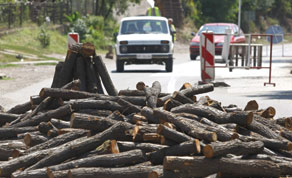
Vehicles approach the road blockade in the village of Leposavic, near Mitrovica, yesterday
Governments in Belgrade and Pristina on Friday endorsed the agreement proposed by the Nato peacekeeping mission in Kosovo (KFOR).
The plan was to restore normality after a trade war escalated into violence, wrangling over borders and violence.
But local Serbs, an overall minority to Albanians but dominant in northern Kosovo, said they would not accept the agreement until it is debated by local authorities.
Meanwhile, the barricades they set on major routes in the area a dozen days earlier would remain in place, they said.
Belgrade and Pristina both abandoned some of the demands they had in their trade row, but local Serbs did not immediately bow to pressure now coming from three sides and dismantle the barricades.
The delay is an act of defiance directed not just at the Kosovo government, which the Serbs do not recognise as their own, and KFOR, but also at Belgrade, analysts said.
Serbian President Boris Tadic’s ruling coalition wants the situation normalised as quickly as possible to limit the damage to its European Union membership aspirations.
But the powerful Serb leaders in Kosovo are closer to the hardline nationalist opposition in Belgrade, which is far more prepared to strain relations with the West in the ongoing tug-of-war.
“The agreement on northern Kosovo is ... fully in the interest of (Kosovo) Serbs and the state of Serbia,” government spokesman Miki Mihajlovic said in a statement yesterday.
Serbia’s chief negotiator for Kosovo, Borislav Stefanovic, warned the Serbs manning the barricades on Friday to accept the deal despite its flaws, or face isolation.
It was not yet clear when the north Kosovo assembly, which is a part of so-called “parallel structures” that resist the rule of Pristina, may take place.
The standoff began on June 25, when the Kosovo government ordered police to seize the two crossings to Serbia proper in the Serb enclaves of Jarinje and Brnjak. Friday’s deal aimed to restore the traffic across the borders.
According to the terms, KFOR would man the checkpoints at least until mid-September, allowing unhindered passenger traffic, but with tighter controls, both on the crossings and along the entire border, to curb illegal crossings and smuggling.
Customs officials jointly appointed by local Serbs and the government in Pristina would eventually take over.
KFOR would stop trucks carrying goods from Serbia – in line with a trade embargo ordered by the Kosovo government in retaliation to an earlier Serbian ban on goods made in Kosovo – but would allow humanitarian aid to come through.
Progress in the talks is crucial for Belgrade’s European Union membership bid.
Tadic is hoping that the EU will already in 2011 formally recognise Serbia as a membership candidate and set a date for the start of accession talks.
Kosovo declared independence from Serbia in 2008, but has remained unable to assert any authority over the Serb north, where Belgrade nurtures its influence by financing the underground parallel authorities.