


AFP/Roses, Spain
World-renowned Spanish chef Ferran Adria served his last meal yesterday at elBulli, the restaurant repeatedly crowned the world’s best which is closing to make way for a culinary research centre.

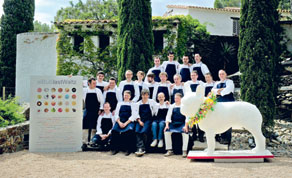
Spanish chef Adria (middle row, fourth from right) and his staff pose for a photograph yesterday before his last dinner at elBulli restaurant near the resort of Roses, some two hours north of Barcelona
Fifty guests – friends and long-time employees of Adria – were treated to a 50-course menu at the remote eatery overlooking a cove in the Mediterranean in Cala Montjoi near the resort of Roses, a two-hour drive north of Barcelona.
Diners began their meal with Adria’s version of a dry Martini – a dish composed of a spherical globule of reconstituted olive that was placed on the tongue and then spritzed with atomised gin and vermouth.
Waiters wearing black T-shirts that read “elBulli the last waltz” then started bringing out the remaining dishes, which included pistachio ravioli, clam meringue, liquid croquetas and olive oil chips.
Adria announced last year that he was closing the Michelin three-star restaurant and replacing it with a culinary think tank, which is scheduled to open in 2014 in a building to be built beside the eatery.
He said that he is dispensing with the restaurant at the height of its fame in order to free up time to be creative in the kitchen.
Overseeing the preparation of dozens of courses each night and fielding the tens of thousands of requests for a table that the restaurant received each year had become draining, he argued.
“We created a monster and it was time to find a way to tame it,” said Adria, the co-owner and head chef of the restaurant since 1987 as he sat at a table outside the eatery with past and current elBulli chefs dressed in white.
“It would be logical for this to be a sad day but it is the opposite, we are happy, very happy because the project will continue.”
The elBulli foundation plans to grant between 20 and 25 scholarships annually for chefs to spend a year working with elBulli’s core staff on new creations. The results will be posted online.
Adria’s trailblazing approach to cooking uses hi-tech methods to take apart and rebuild foods in surprising ways.
The restaurant, reached by driving along a winding mountain road surrounded by pine and olive trees, is credited with pushing the boundaries of cuisine and helping transform Spain from a culinary backwater to a world leader.
Britain’s Restaurant magazine ranked it number one on its list of the world’s top 50 restaurants a record five times – in 2002 when the list was first published and for four years in a row through 2009.
Several chefs who worked at elBulli and went on to found top restaurants of their own credit the freedom they had to break culinary rules during their time at the eatery for their success.
“The courage and freedom to do what we do at our restaurant came from here. And that is like finding a treasure,” said Rene Redzepi, head chef and co-owner of Noma in Copenhagen, which deposed elBulli at the top of Restaurant magazine’s rankings last year. “I would like to thank everyone here for helping free my imagination.”
Noma was ranked the world’s best restaurant in 2011 for the second year in a row. ElBulli was not included in the rankings this year because it was closing.
“To see someone taking risks and expressing themselves through cooking, through food, it lights a fire,” said Grant Achatz, the head chef at Chicago’s acclaimed Alinea restaurant who also spent time at elBulli.
ElBulli was open only half the year. Staff at the 50-seat restaurant annually fielded more than 2mn requests for its roughly 8,000 sittings, with tables in the rustic dining room allotted mostly by form of lottery.
Dinner was a menu of between 30 and 50 small dishes, which cost 270 euros ($385) not including tax, drinks or tip.
But despite its popularity, the restaurant was losing 500,000 euros a year, in part because preparing the dozens of items on the menu often involved more chefs in the kitchen than the diners it hosts in one night.
It made up the shortfall through a series of elBulli spin-offs, including books, a range of kitchenware, speaking engagements and by lending Adria’s name to a range of products, from olive oil to cutlery.