


AFP/Nairobi
The UN has officially declared famine in two southern Somalia regions as the world slowly mobilised to save the 12mn people battling hunger in the region’s worst drought in 60 years.

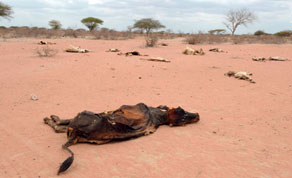
The carcasses of livestock are seen in Athibohol, northeast of Nairobi. Close to 1.4mn people in the region are in dire need of relief food, as a result of the prolonged drought. The situation has been worsened by the failure of the April rains with weathermen foreseeing a severe drought in October
The United States urged the Al Qaeda-inspired rebels controlling the area to allow the return of the relief groups that they expelled two years ago while aid groups warned many would die without urgent action and funding.
UN Humanitarian Affairs Co-ordination for Somalia Mark Bowden declared that southern Bakool and Lower Shabelle regions had been hit by famine.
The UN said that an estimated 3.7mn people – or nearly half of the war-torn country’s population – were facing a food crisis.
“If we don’t act now, famine will spread to all eight regions of southern Somalia within two months, due to poor harvests and infectious disease outbreaks,” Bowden told reporters.
“If we are not able to intervene immediately, tens of thousands more Somalis may die,” the UN added.
Somalia, which has been affected by almost uninterrupted conflict for 20 years and become a by-word for “failed state”, is the worst affected nation but parts of Kenya, Uganda, Ethiopia and Djibouti are also hit.
The United States urged neighbouring Eritrea, one of the most secretive countries in the world, to reveal the scope of its own food situation.
“Given the combination of severity and geographic scope this is the most severe food security crisis in Africa since the 1991/2 Somalia famine,” the United Nations added.
Famine implies that at least 20% of households face extreme food shortages, acute malnutrition in over 30% of people, and two deaths per 10,000 people every day, according to UN definition.
The Shebab expelled foreign aid groups two years ago, accusing them of being Western spies and Christian crusaders.
However, the UN last week airlifted in the first supplies since the group said it would lift restrictions on aid.
Malnutrition rates in Somalia are currently the highest in the world, with peaks of 50% in certain areas of southern Somalia, Bowden said.
“Every day of delay in assistance is literally a matter of life or death for children and their families in the famine affected areas,” Bowden said.
Over 78,000 Somalis have fled to seek refuge in neighbouring Ethiopia and Kenya in the last two months.
In Kenya, they are streaming into overcrowded camps hosting some 380,000 people – more than four times the original capacity.
On Tuesday, the UN refugee agency said death rates among refugees arriving in Ethiopia’s Dolo Ado area reached 7.4 per 10,000 in June, 15 times more than the baseline rate in sub-Sahara Africa.
Somalia’s embattled government welcomed the famine declaration – the first since the term was defined by the UN in 2008 – as a sign that the world was beginning to acknowledge the scope of the disaster.
“At least it is great that the world has recognised the magnitude of hardship the poor Somalis are facing,” Abdulkadir Moalim Nur, a minister in the president’s office, told AFP.
The Food and Agricultural Organisation appealed yesterday for $120mn for the 12mn drought victims in the Horn of Africa.
Aid group Oxfam said only $200mn of the needed $1bn had been provided.
“There is no time to waste if we are to avoid massive loss of life. We must not stand by and watch this tragedy unfold before our eyes,” said Fran Equiza, Oxfam’s regional director.
The government’s authority over the vast country is limited and Johnnie Carson, the US assistant secretary of state for African affairs, stressed that the Shebab’s responsibility in the suffering was clear.
A top Shebab official welcomed the UN’s famine declaration, saying that they would allow aid through.
“The declaration of famine in parts of Somalia by the UN is welcome and we would like to see aid coming to the people,” a senior Shebab official told AFP on condition of anonymity.
“Aid must be provided purely on a humanitarian basis, and the religious value of Somalis as Muslims must be respected,” the official added.
UN agencies will hold a meeting on Monday in Rome over the drought-sparked humanitarian crisis as the world’s top leaders called for mass mobilisation to contain one of the planet’s worst unfolding humanitarian disasters.