


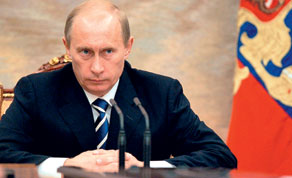
Reuters/AFP/Berlin
 |
| Vladimir Putin |
A prominent German prize for freedom and democratic change will not be awarded this year after the independent award committee’s decision to give it to Russian Prime Minister Vladimir Putin was criticised.
“There will be no prize this year,” said a spokesman for the board of trustees that awards the Quadriga prize every year. “We will see how it continues next year.”
The Werkstatt Deutschland organisation cited “massive criticism in the media and the political world” over its plans to give Putin the private Quadriga Award that recognises “role models for enlightenment, dedication and the public good”.
The Quadriga panel voiced “great regret” that it was forced to retract the prize, but said “the growing pressure was becoming increasingly unsustainable and risked escalating further”.
Organisers “apologised to everyone involved”.
The decision comes just days before German Chancellor Angela Merkel meets Russian President Dmitry Medvedev to discuss deepening ties. They are due to meet tomorrow and on Tuesday.
Putin, a former KGB spy who was once stationed in East Germany, had been chosen as one of four 2011 Quadriga prize winners for his contribution to the stability and reliability of German-Russian relations, a spokesman said earlier this week.
Senior members of Germany’s coalition this week criticised the choice, saying that it undermined the Quadriga award, which is normally handed out on the October 3 national holiday celebrating German unification in 1990.
Others questioned Putin’s democratic credentials.
Putin’s spokesman was not available for comment.
Russian opposition groups say that Putin led a clampdown on civil liberties during his presidency from 2000 to 2008.
The United Nations and US State Department have criticised Russia’s human rights record and the European Parliament urged Russia last week to guarantee free elections.
The Kremlin has dismissed such criticism.
The Quadriga award annually honours people who are “role models for and from Germany” and is “dedicated to all those whose courage tears down walls and whose commitment builds bridges”.
Putin has enjoyed close relations with former chancellor Gerhard Schroeder and helped the retired German leader secure a supervisory board position at a Russian-German energy company.
The German Foreign Office declined to comment, saying that it was a private decision by a private organisation. The Russian embassy also declined to comment.
Former Soviet leader Mikhail Gorbachev, former Czech president Vaclav Havel, German Finance Minister Wolfgang Schaeuble, Greek Prime Minister George Papandreou and Turkish Prime Minister Recep Tayyip Erdogan are among previous winners.
Havel has welcomed the organisation’s decision to retract the prize.
“Vaclav Havel thinks it was very wise of the panel to reconsider its choice,” Havel’s secretary Sabina Tancevova told AFP.
“The award should be given to people like Anna Politkovskaya or Sergei Kovalov or Liu Xiaobo – people who devoted their lives to protection of human rights and freedoms and promoting democracy,” she added.
The German media reported earlier that Havel wanted to return his award in protest at Putin’s nomination.
The Quadriga prize has been awarded every year since 2003 on October 3, the anniversary of German unification.
Putin entered the Kremlin as president in 2000 and remained until 2008.
In that time the state wrested back control of major media outlets, subjected rights groups to a wave of new restrictions and dealt harshly with perceived opponents.
He now serves as prime minister and has remained the country’s most popular politician.
Neither he nor current president Dmitry Medvedev have said which of them will run in presidential elections scheduled for March.