


 |
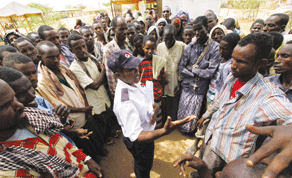
| Newly arrived Somali refugees listen to a private security guard explaining a registration procedure at Ifo camp, one of three camps that make up sprawling Dadaab refugee camp in Dadaab, northeastern Kenya. The Kenyan government has agreed to open up two new refugee camps at Dadaab to accommodate increasing number of refugee influx from Somalia amid the worsening drought in the region |
The facility, Ifo II in northeastern Kenya could house around 80,000 people and would be opened in just under two weeks, Prime Minister Raila Odinga said. The US and UN both welcomed the move.
“We are enormously heartened ... that the government will support the opening of the Ifo II extension camp, something that the international community has been concerned about for the last couple of years,” said Reuben E Brigety, a US Deputy Secretary of State, while visiting Kenya.
The Horn of Africa region is suffering its worst drought in some six decades, which is compounding the pre-existing humanitarian crisis in Somalia, caused by 20 years of civil war and failed central government.
The new camp was expected to help ease overcrowding at the Dadaab refugee complex, the largest in the world, about 100km from the Kenya-Somalia border.
Some 439,000 people are housed at Dadaab, according to the UN, most having fled Somalia’s conflict and many are now seeking refuge in the 50-square-kilometre camp from a drought affecting the entire Horn of Africa.
“The majority of new arrivals actually fled because they had nothing to eat, not just because their country has been at war for decades,” said Anita Sackl, the coordinator of the nutritional assessment programme at Doctors Without Borders (MSF).
Aid agencies estimate some 10mn people are at risk of hunger.
The UN has warned it is still lacks funds to help those in need, with the World Food Programme noting it has received only about half of the $20mn for which it has appealed.
However, a new camp would likely help agencies administer aid to refugees and better register and monitor people in need.
The Kenyan government had been hesitant to authorise the opening of the camp for people from Somalia, saying that the security risk was too great and fearing that the refugees would settle permanently.
There was also growing concern over infiltration by the Somali insurgent group Shebab.
UN High Commissioner for Refugees Antonio Guterres had appealed this week to Kenya to open the camp and welcomed the announcement that the facility would function soon.
His office would send 700 tonnes of aid by planes in the coming week, starting on Sunday, including urgently needed tents.
He described the situation in the region as the world’s “worst humanitarian disaster” and appealed to the international community for assistance.
The World Health Organisation (WHO) warned that there was an “increased risk of communicable disease transmission” owing to the deteriorating situation in the eastern Africa region, with millions at risk of choleric and malaria.
“The need to provide emergency health care to severely malnourished children is increasing,” said WHO spokesman Tarik Jasarevic, who cautioned that his organisation’s budget for the Horn of Africa was in a severe financial shortfall.