


AFP/Cyprus
 |
|
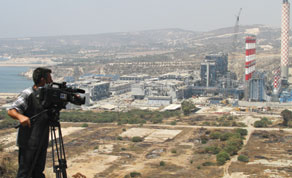
View of the destroyed Vasiliko Power Station in Mari Cyprus |
Frustrated Cypriots were using social networking sites and mobile texts to organise protests against what they perceived as government negligence in not preventing the island’s worst peacetime military accident.
A large protest was being organised in the capital Nicosia.
A huge blast on Monday in a seized Iranian arms cache at a Greek Cypriot naval base on the south coast killed 12 people and injured 62, two of whom remained in critical condition.
The power and water outages come at the height of a scorching summer.
The commander of Cyprus’s navy, Andreas Ioannides, was among the dead, as was the commander of the Evangelos Florakis naval base, Lambros Lambrou.
Four other members of the armed services and six firefighters also died. Cyprus entered its second day of national mourning with flags on public buildings at half mast and all government events cancelled.
But the media were in no doubt that the blast was avoidable and the government had a lot of unanswered questions to address.
Although Defence Minister Costas Papacostas and Greek Cypriot National Guard commander Petros Tsaliklides resigned shortly after the disaster, President Demetris Christofias also came under fire.
There were informal protests and candle-lit vigils late on Monday in which the government was called on to resign and Tuesday’s newspapers produced some chilling headlines.
“It’s a crime,” screamed the front-page headline in pro-opposition daily Alithia (The Truth).
It said small explosions were recorded at the arms cache several days before the killer blast but pleas to navy commander Ioannides to remove the containers were ignored.
The English-language Cyprus Mail called it a “criminal error,” while squarely putting the blame on Christofias.
The paper said in an editorial that it was a “disaster that could have been avoided if our country was run by a less incompetent president”.
The independent Politis daily ran with the headline: “Criminals: 12 dead and the economy in darkness because of criminal apathy.” A picture of buckled containers exposed to the sun only 300m from the island’s largest power plant was splashed over its front page. Relatives of the victims have been asking why the explosives were piled high in the open air without any protection.
Top selling newspaper Phileleftheros summed it up with the words: “Crime and tragedy.”
The Vassiliko plant, which accounted for almost 60% of the island’s electricity supply, was devastated by the force of the blast and is expected to remain out of operation for months or even years.
The Electricity Authority of Cyprus (EAC) announced yesterday that various areas across the island would receive rolling two-hour power cuts “because of a lack of capacity.”
But the electricity authority said it would try to assure uninterrupted supplies to airports, ports, hospitals, and industrial and tourist areas.
With residents urged to save energy and water to try to ensure businesses, hotels and industry keep going, the Cyprus Energy Regulatory Authority issued a decree making it compulsory to use generators where available.
A huge mobile generator was scheduled to arrive from Greece to help the resort island cope with the peak holiday season. EAC chairman Charis Thrassou warned that the cost of repairs was likely to run to well over a billion euros ($1.4bn).
Loss of supply also prompted the closure of desalination plants which had allowed the gradual abandonment of summer water rationing over the past two years.
Cyprus had attempted several times to offload a dangerous cargo of confiscated Iranian munitions that blew up on Monday killing 12, but was rebuffed by the UN, a senior official said.
Attempting to fend off mounting criticism over Cyprus’s worst peace-time disaster, authorities said they had tried in vain to get rid of the 98 containers of munitions they confiscated in 2009 from a ship sailing from Iran to Syria.
“Our government’s position in this difficult diplomatic issue was that the material not be held in Cyprus,” said Stefanos Stefanou, the government spokesman.
He said, however, Cyprus had no choice but take the arms cargo in after its suggestions it went to the UN peacekeeping force in Lebanon was rejected, and it received no answer from the Security Council that the material be sent to Germany or Malta.
The economic impact of the disaster has yet to be assessed.
The weapons-grade material confiscated was in violation of UN sanctions on Iran, and therefore the UN had to be involved in consultations about its fate, Stefanou said.
Cyprus had revisited the matter “from time to time” with the UN without success, he added.
Left stacked in scorching heat at a military base, one of the containers containing gunpowder had apparently expanded, letting off a “hissing noise” in the days preceding the blast, military sources said.
Warnings from officers to their seniors that it was a disaster about to happen went unheeded, relatives of the victims said.
However, it had never been discussed in cabinet meetings, Stefanou said. “The presidency was not aware of this,” he said.
Two of the victims, twin 19 year old conscripts, had been assigned to douse the stack regularly with water to keep temperatures down, their family said.
“Which idiot decided to place 98 containers of explosives in a compound ... directly opposite the largest energy facility the Cyprus Republic now has?” the daily Politis asked, splashing the word “Criminals” on its front page.
“Whether the president was in oblivion, or is just scared of the responsibility, its difficult for him to convince us he can run this country.”