


Reuters/Canberra
 |
|
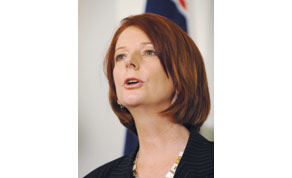
Gillard: we are going to get this done |
Prime Minister Julia Gillard said that 500 companies including steel and aluminium manufacturers would pay a A$23 ($24.70) per tonne carbon tax from next year, rising by 2.5% a year, moving to a market-based trading scheme in 2015.
“It’s time to get on with this, we are going to get this done,” said Gillard after a bruising battle to win political support for the scheme, which has polarised voters and business.
A parliamentary vote on the scheme is expected before year-end.
Australia is the developed world’s worst per-capita greenhouse gas emitter because of its heavy reliance on cheap coal for power generation.
Emissions are set to rise in the booming economy without a carbon cost, the government says.
The stakes are high for Gillard’s Labor party, which relies on the support of Greens and independents for a one-seat lower house majority. Her popularity has slumped to record lows over the scheme.
With the details now finally released after months of waiting, Gillard will now try to convince voters opposed to the plan ahead of a parliamentary vote, trying to deflect a campaign against it by the hardest hit businesses.
“It is absolutely critical that the government sells this very effectively,” said Tony Wood, director of the energy programme at the Grattan Institute, a policy think tank.
Australian retail and clean-energy stocks were expected to be among the winners, and airlines and miners among the plan’s losers, but analysts said financial markets overall were tipped to take the policy in their stride.
The scheme aims to cut national emissions by 5% of 2000 levels by 2020, which would mean a cut of about 160mn tonnes.
The package already has the broad support of the Greens and independents, although crossbenchers said they had yet to support extra measures to protect steelmakers and jobs in the vital coal industry.
Parliament twice rejected previous attempts to price carbon in 2009 and any fresh rebuff in a vote expected around October would seriously threaten Gillard’s government.
The danger is that a vigorous campaign by the conservative opposition and business groups opposed to the tax could erode public support and frighten political backers ahead of elections due by 2013.
“This tax is going to go up and up and up as time goes by. I think this package is going to compound the trust problem that has dogged the prime minister. This package certainly sets up the next election to be a referendum on the carbon tax,” said conservative opposition leader Tony Abbott.
Abbott has seized upon voter fears of a new tax and higher costs from a scheme that aims to transform how the nation generates and uses energy across the economy.
To neutralise opposition, Gillard said more than A$24bn to be raised from pollution permit sales over the next three years would go to households through generous tax cuts worth more than A$15bn.
Australia’s scheme will cover 60% of carbon pollution apart from exempted agricultural and light vehicle emissions, with Treasury models showing it would boost the consumer price index by 0.7% in its first year, in 2012-13 (July-June).
It could also aid global efforts to fight carbon pollution, which have largely stalled since US President Barack Obama last year ruled out a federal climate bill his present term.
Outside the EU, only New Zealand has a national carbon scheme.
“Other countries will look at one of the most carbon polluting economies on the planet that has made one huge stride forward towards putting a price on carbon,” said John Connor, chief executive of the Climate Institute.
Australia said it hoped to link its scheme, which would cost A$4.4bn to implement after household and industry compensation, to other international carbon markets and land abatement schemes when its emissions market was running.
Europe’s system, which covers the 27 EU member states plus Norway, Iceland and Liechtenstein, has forced power producers to pay for carbon emissions, driving cuts where power plants were forced to switch to cleaner natural gas or biomass.
Gillard said that her government would spend A$9.2bn over the first three years of the scheme to ensure heavy polluting industries like steel and aluminium production were not killed off, and help close the oldest and dirtiest power stations.
Assistance would come from free carbon permits covering 94.5% of carbon costs for companies in the most emissions-intensive and trade-exposed sectors, such as aluminium smelters and steel manufacturers, while moderate emitting exporters would get 66% of permits for free.
Coal miners, including global giants Xstrata Ltd and the coal arms of BHP Billiton , would be eligible for a A$1.3bn compensation package to help the most emissions intensive mines adjust to the tax, which would add an average A$1.80 per tonne to the cost of mining coal.
“We support action on climate change but are disappointed at the government’s lack of genuine consultation,” said Xstrata Coal spokesman James Rickards in a statement.
The Minerals Council of Australia criticised the scheme as a “dangerous experiment with the Australian economy”.
Australia, a major coal exporter, relies on coal for 80% of electricity generation, which in turn accounts for 37% of national emissions.
The government would also establish loan guarantees for electricity generators through a new Energy Security Fund, to help the industry refinance loans of between A$9bn and A$10bn over the next five years.
The government would fund the shut-down or partial closure of the dirtiest brown-coal generators in Victoria state and remove up to 2,000 megawatts of capacity by 2020, replacing them with cleaner gas, while short-term loans would help them re-finance debt and buy permits.
Australia’s booming liquefied natural gas (LNG) sector, which is due to decide on A$90bn worth of new projects, would also be included in the scheme, despite calls for 100% protection.
The sector will receive 50% assistance, Climate Change Minister Greg Combet said.
Steelmakers, including Australia’s largest, BlueScope and OneSteel Ltd, will receive 94.5% of free permits and A$300mn in grants to help support jobs.
The scheme also set-up a A$10bn Clean Energy Finance Corp to fund new renewable and cleaner generation capacity, such as wind, solar, gas and wave power plants.
“This is the moment where Australia turns its back on the fossil fuel age, and turns its face towards the greatest challenge of the 21st century, and that is addressing global warming,” said Australian Greens deputy leader Christine Milne, whose party wields the balance of power in the Senate.
To soothe voters, with polls showing 60% opposition to a carbon tax, the government has offered tax cuts to low and middle-income households, as well as increased state pension and welfare payments.
Treasurer Wayne Swan said that all taxpayers earning below A$80,000 a year would get tax cuts worth around A$300 a year, which analysts said could actually help boost the struggling retail sector, where spending has been sluggish.
Many analysts broadly praised the scheme.
“It is much more than a carbon tax. It is a comprehensive suite of measures that together can not only reduce our emissions, but also encourage growth of innovative, green technologies, industries and jobs,” said Caroline Bayliss, Australia Director of The Climate Group, an international advisory and NGO.