


 |
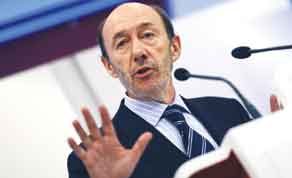
| Rubalcaba: due to be officially confirmed as the Socialist candidate today |
Polls show that Rubalcaba, one of Spain’s most respected politicians due to his success while interior minister in weakening ETA Basque separatist guerrillas, is still likely to lose to centre-right opposition leader Mariano Rajoy.
With one in five of the labour force out of work, the highest jobless rate in the European Union, Rajoy’s Popular Party (PP) has a 10 to 14-point lead in opinion polls.
A general election is due by March next year, but analysts say Rubalcaba is pushing unpopular Prime Minister Jose Luis Rodriguez Zapatero to bring it forward to November so he can take advantage of a likely summer upswing in the sluggish economy.
“I’ve told the prime minister my desire to quit the government and to do it immediately,” 59-year-old Rubalcaba, a chemistry graduate and former sprinter, told reporters at the government’s weekly cabinet news conference.
Zapatero has already said he will not run for a third term in office.
The Socialists have declined in popularity as he has implemented austerity measures to tame the budget deficit but failed to bring down unemployment.
The Socialists, or PSOE, are scheduled to officially confirm today that Rubalcaba is their candidate.
“This gives him time to develop his programme, especially as he tries to differentiate himself from Zapatero, which is going to be a tough job,” said Emilio Ontiveros, head of Madrid’s International Financial Analysts.
Voters shunned the Socialists in local polls in May, leading to the PSOE’s worst results at municipal level for decades.
Opinion polls show Rubalcaba’s best hope is to keep the PP from taking an absolute majority in parliament.
In recent weeks he and other cabinet ministers have made gestures to the fragmented left – supporting mortgage relief for unemployed borrowers and lashing out at bankers.
These moves are aimed at winning back traditional Socialist voters who abstained, cast blank ballots, or defected to smaller parties in May.
Experts do not give them much credence given Zapatero’s austerity measures and market-friendly labour reforms to try to keep Spain from being sucked into the euro zone debt crisis.
“No one believes it. The left will fragment even more,” said Fernando Vallespin, professor of political science at Madrid’s Autonomous University.
The PP has been cautious about laying out detailed policies, not wanting to give out tough messages that will erode support.
But PP politicians say in private that Rajoy, 56, would move swiftly in his first months in office to deepen economic reforms and boost international investor confidence.
Spain is paying almost three percentage points more than Germany to borrow money because investors fret weak economic growth will make it hard for the country to meet its ambitious targets to reduce the deficit.