


Reuters /Mogadishu
 |
|
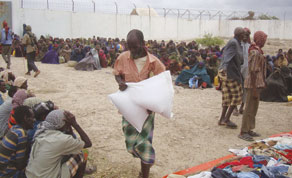
A man carries a sack of grain at a displaced persons camp in Shebelle, about 50km south of the capital Mogadishu, yesterday |
“We have now decided to welcome all Muslim and non-Muslim aid agencies to assist the drought-stricken Somalis in our areas,” Sheikh Ali Mohamud Rage, Al Shabaab spokesman, told a news conference in Mogadishu late on Tuesday.
“All aid agencies whose objective is only humanitarian relief are free to operate in our area,” Rage said, adding they should first contact Al Shabaab’s drought committee.
Al Shabaab fighters, who profess loyalty to al Qaeda, control central and southern parts of the country. In the past, they said food aid created dependency.
The UN says 2.8mn people in Somalia need emergency aid. In the worst-hit areas, one in three children is suffering from malnutrition.
Local analysts in Somalia said Al Shabaab lifted the ban to generate money to fund their war effort. Al Shabaab previously told aid agencies to pay a hefty registration fee.
That has pushed increasing numbers of people to flee into government-controlled territory seeking assistance.
On Tuesday, Al Shabaab soldiers blocked two trucks carrying people from southern Somalia to the capital, Mogadishu, in the hope of finding food and water.
“Al Shabaab fighters said they would not allow people to flee to Mogadishu, which is ruled by infidels,” shopkeeper Ali Hussein said by phone yesterday from Afgoye, 40km outside the Somali capital.
“Al Shabaab said it would open kitchens for them.” About half of Mogadishu is controlled by the Western-backed transitional federal government.
The senior UN humanitarian official for Somalia welcomed the news of the lifting of the food aid ban.
“I am happy to cooperate with anybody who can work to alleviate the current crisis to save hundreds of Somali lives,” said Mark Bowden, UN humanitarian coordinator for Somalia, who is based in the Kenyan capital, Nairobi.
The U.N World Food Programme would not comment. It pulled out of southern Somalia in 2010 because of threats against its staff and demands by Al Shabaab of payments for security.
The world’s biggest food agency has also faced challenges from donors after a local WFP contractor was exposed last March as a Somali businessman with links to Al Shabaab.
“We don’t have anything to eat,” said Sainab Yusuf Mohamed, whose child died as they were trekking across the desert in search of help. “As we were burying his body, my second child died,” she said by telephone from Bardhere District in southwest Somalia.
The European Union executive yesterday announced an immediate €5.67mn ($8.1mn) of aid to help alleviate the plight of Horn of Africa drought victims streaming into the Dadaab camp in Kenya.
The aid brought to almost 70mn the bloc’s contribution to assistance after the worst drought in 60 years affecting parts of Ethiopia, Kenya, Somalia and Djibouti.
Dadaab, the world’s largest refugee camp, has seen an influx of 61,000 Somalis since the beginning of the year, 20,000 of them in the last two weeks. The refugee population there currently stands at 380,000.
“Dadaab is just the starkest reminder that the spectre of hunger has returned to Africa,” said aid commissioner Kristalina Georgieva.