


Reuters/AFP/Rome
Italian Prime Minister Silvio Berlusconi overcame coalition infighting to win a vote of confidence yesterday, his first parliamentary test since suffering two stinging electoral losses.

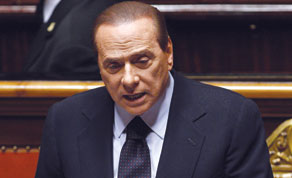
Berlusconi making a speech during debate at the Senate. He overcame coalition in-fighting to win a vote of confidence
Berlusconi’s centre-right government won the lower house vote on measures to boost growth by a margin of 24 votes, thanks to its Northern League ally that is reluctantly supporting him after defeat in referendums and local polls over the past month.
The motion passed with 317 deputies voting in favour and 293 against. Two lawmakers abstained.
The victory is likely to provide only brief respite for Berlusconi, who faces plummeting approval ratings, squabbling allies and a faltering economy.
Analysts warn Italy could pay a heavy price for failing to push through reforms and ratings agencies Standard & Poor’s and Moody’s both lowered their outlook on Italy over the past month, citing doubts about its ability to cut huge public debt.
“The window of opportunity for the government to set the pace of the policy agenda is closing,” Barclays Capital analysts said in a note. “Markets are likely to demand higher spreads unless Italy switches gears soon.”
But Berlusconi is battling to keep his coalition together, with an increasingly frustrated League demanding tax cuts and an end to Italy’s costly mission in Libya.
Asked if Berlusconi would see out the end of his term in 2013, the League’s mercurial leader Umberto Bossi bluntly said: “If he does the right things, yes. We’ve already given Berlusconi a timeline.”
Berlusconi voiced defiance yesterday, saying that he would stay in power until his mandate runs out in 2013 despite crushing defeats in local elections and a round of referendums.
“I’m sure the government will come out of this stronger than before,” the 74-year-old leader said, rejecting recent calls for his resignation as “propaganda” and left-wing irresponsibility which threatened to spark a political crisis that would be disastrous for Italy’s economy.
“We firmly intend to implement our governing programme until 2013,” said the three-time prime minister.
Shrugging off a sharp drop in popularity in recent weeks, the premier said no opposition party or leader could replace him.
Berlusconi took comfort in the symbolic victory of winning the confidence vote.
The premier called for unity after a trouncing in mid-June referendums that left the government on the back foot by wiping out his plans to return Italy to nuclear power and quashing a partial immunity law designed to keep him out of court.
The defeat was a second blow to the embattled premier in less than a month, after his party lost critical mayoral votes in Milan and Naples in May.
The embarrassing setbacks have led to tensions within the government, with Berlusconi’s coalition partner – the populist Northern League party – on Sunday issuing a series of demands to be met in exchange for its continued support.
Berlusconi dismissed reports of a split as a ploy by the opposition to undermine the government: “I have a strong friendship with the League. They have tried everything to split us up, but they will never succeed.”
He warned against the “locusts of speculation” waiting to devour Italy’s economy and told parliament that a political crisis would be a “disaster” for the country.
“The economic policies of this government have saved us from the threat of financial default,” Berlusconi said.
“We will avoid ending up like other European countries that are being bled to survive,” he said, adding: “An incredible result for our government is having sheltered our public debt from speculative attacks.”
Referring to calls for his resignation following his poll setbacks, he said: “It would be crazy to throw everything into question and render ourselves vulnerable with a crisis just as we need to re-start economic growth.”
“It would be a disaster... for Italy and for its financial stability.”
“The ratings agencies are monitoring us and the locusts of speculation are only waiting for the right moment to pounce on their prey,” he said.
Berlusconi said his government was committed to structural reforms.
An overhaul of the tax system, which would reduce the number and level of income taxes in Italy and reduce exemptions and evasion while not increasing overall public debt, will be presented to parliament later this year, he said.
A separate vote in the lower house to verify whether the government enjoys a majority may be called today.
Berlusconi faces a bigger test in coming weeks when he must push through austerity measures totalling about 40bn euros ($57bn) to eliminate the budget deficit by 2014 – a task made even more arduous by the League’s demand to cut taxes.
In a reminder of the price of inaction, Moody’s said on Friday it may cut the country’s rating over concerns about its ability to bring down a public debt mountain equivalent to about 120% of gross domestic product.
The head of Fitch’s sovereign ratings unit told Reuters yesterday that the agency has no plans to change its rating or outlook on Italy at the moment, but warned that any tax cuts that are not matched by spending cuts would be worrying.
Well-known for bouncing back from the most difficult of situations, Berlusconi managed to wave off a series of sex scandals soon after sweeping to power in 2008.
But his fortunes began to wane after an acrimonious split with Gianfranco Fini, his old ally, last year that ended his guaranteed parliamentary majority.
A string of corruption cases, a faltering economy and a scandal involving an underage prostitute have taken their toll on the premier, whose support among voters now stands at a record low of 29%, according to pollsters IPR.
The government’s sagging support even among its core northern power base was underscored by the loss of the Milan mayoral seat in local elections last month. That was followed by defeats in referendums on nuclear energy, water privatisation and trial immunity for government ministers.