


AFP/Berlin
The Greens pushed Angela Merkel’s conservatives into third place in a regional vote yesterday, as Social Democrats who have ruled Bremen state for 66 years came out on top, an exit poll said.

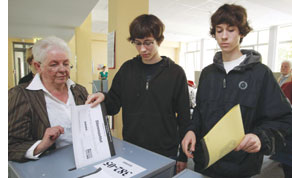
Sixteen-year-old twins Johannes (right) and Jan-Phillip Kuessner cast their ballots in Bremen yesterday
The result is seen as a further drubbing for Chancellor Merkel after four other regional elections this year saw her conservative Christian Democrats (CDU) lose support.
The Social Democrats (SPD) took 38% of the vote, while their Green allies took 23%, public television reported, quoting an exit poll.
The CDU came third with 21.5%, while its allies in the federal government, the Free Democrats (FDP), won just 3% of the vote, less than the minimum 5% needed to send representatives to the local assembly.
Final results might not be known for several days because of a complicated ballot counting system.
The regional election for the first time involved voters as young as 16.
The number of 16- and 17-year-olds casting ballots in Bremen, the first of Germany’s 16 states to allow under 18s to vote, was however less than 2% of the state’s 500,000 voters, and was unlikely to significantly affect the result.
Only a handful of countries allow 16-year-olds to vote, including Austria, Equador, Nicaragua and Brazil.
In federal and regional elections in Germany’s other 15 states voters must be at least 18, while seven states allow 16-year-olds to vote in municipal polls.
The conservative-liberal federal government, which has already lost control of the Bundesrat upper house of parliament, made up of representatives from the regional states, has seen its support eroded in every election so far this year.
In March, the CDU even lost Baden-Wuerttemberg, a southwestern state which it had governed for nearly six decades.
The FDP, for its part, has gone from bad to worse, failing to win seats in two of the four state elections held to date and faring scarcely better in a third.
The Greens, by comparison, have gone from strength to strength, helped in part by worries over nuclear energy in the wake of the Japanese nuclear power plant disaster.
Bremen has been run by the left-wing SPD since the end of World War II.
Bremen was the first regional state to elect environmentalists in 1979.
In 2009, its regional assembly decided to allow 16-year-olds to vote in a bid to boost young people’s interest in the political process.
Since then, a number of top politicians, including Claudia Roth, co-chairperson of the Greens, Miriam Gruss, a spokeswoman for the FDP, and Franz Muenterfering, a former SPD leader, have all called for lowering the voting age to 16 in federal elections.
“Bremen will allow for taking the pulse of the German electorate, but won’t impact the Merkel government’s room to manoeuvre,” according to Nils Diederich, a political scientist from Berlin’s Free University.
In addition, “parties in power (at the federal level) traditionally tend to do poorly in regional polls held between general elections”, according to Gerd Langgruth, a political scientist in Bonn, the former capital.