


Agencies/Moscow
President Dmitry Medvedev yesterday warned of a new Cold War era if Russia and the West failed to agree on missile defence, in the first major news conference of his presidency.

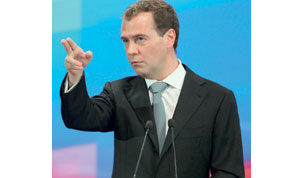
Russian President Dimitry Medvedev gestures during his annual press conference at the Moscow School of Management in Skolkovo, outside Moscow
Despite the startlingly warning to the US and Europe, Medvedev confounded expectations he would use the event to finally announce if he intends to seek a new Kremlin mandate in 2012 elections.
Russia is increasingly worried about US plans to build missile defence facilities in ex-Communist eastern Europe and is also offended that Nato appears to have shunned its proposals for a joint missile defence shield.
Medvedev told reporters that the US decision to push ahead with construction of the missile defence system despite Russia’s objections will force Moscow “to take retaliatory measures - something that we would very much rather not do.”
“We would then be talking about developing the offensive potential of our nuclear capabilities. This would be a very bad scenario.”
The Russian leader also reiterated an earlier threat to pull out of the new START disarmament agreement that entered into force this year if the missile shield is deployed and operated without the Kremlin’s input. “This would be a very bad scenario. It would be a scenario that throws us back into the Cold War era.”
Moscow has been fighting Nato plans to deploy a system the West sees as a means of protection from nations such as Iran but Russia believes could potentially be deployed against its own defences.
Medvedev yesterday demanded a legally-binding assurance from the US that this will never happen - a safeguard that Moscow says Washington is refusing to give.
Nato has thus far invited Russia to voice its concerns in formal meetings but refused to provide Moscow with a formal role in the shield’s operation that it seeks.
“We would like to see missile defence develop under clear rules,” Medvedev said in the first broad-ranging press conference of his three-year presidency.
In a bid to show his ability to talk tough on big issues like his predecessor Vladimir Putin, Medvedev also bluntly told Ukraine to decide whether it wanted closer ties with Russia or seek European Union integration.
“You cannot be everywhere. Either here or there. Everyone should understand that, including my Ukrainian friends and colleagues: you cannot sit on two chairs, you have to make some choice,” Medvedev said.
The news conference, at a technology hub on the outskirts of Moscow, was broadcast live on Russian state television. Medvedev stood, US presidential style, alone at a lectern against the backdrop of the Russian flag.
Hundreds of reporters attended the news conference, in a major event for Medvedev who so far has only spoken to the press alongside foreign leaders or in small scale briefings.
Seeking to show his confidence, Medvedev chose each question apparently at random from journalists in the audience, many of whom concentrated on local issues.
But despite intense speculation that he wants to stand for a new presidential term instead of Prime Minister Putin, Medvedev refused to say if he intended to seek a new mandate in 2012.
“This kind of decision has to be made when all the conditions are right, when it has the final political effect,” Medvedev said.
“This does not mean that this can last for ever... As I said in the interview to your Chinese colleagues, this decision will come fairly soon,” he said, referring to a recent interview with Chinese television.
Medvedev said it was wrong for rulers to stay in power for too long, although he made these comments in reference to Russia’s powerful regional governors whom he has reshuffled drastically in the last years. “No-one stays in power for ever. And if anyone has that kind of illusion then they will end badly,” said.
In comments that differentiated him from his mentor, Medvedev called for modernisation to diversify the $1.5tn economy away from reliance on oil and gas revenues, 20 years after the collapse of the Soviet Union.
“As far as I understand, he (Putin) believes modernisation is a calm, step-by-step process. I think we have the chances and the energy to conduct modernisation more swiftly without damage to what has already been done, and to achieve good results.”
Medvedev also differed with Putin on the case of oil tycoon Mikhail Khodorkovsky, jailed for theft and money laundering after trials criticised by the West as politically motivated.
Khodorkovsky, once Russia’s richest man, was arrested in 2003 after falling foul of the Kremlin during Putin’s presidency, and his oil company was brought to its knees by back tax claims. Its main assets were sold off by the state.
Asked whether it would be dangerous for society to release him, Medvedev said: “Absolutely not dangerous at all.”
A majority of Russians still regard Putin as the country’s paramount leader. President from 2000-2008, he has sought this month to broaden his political backing before a parliamentary election in December and the March 2012 vote.
Medvedev’s remarks were unusually bold but analysts have cautioned against reading too much into the two leaders’ public comments on the presidency, and many suggest moves are being carefully orchestrated in the run-up to the election.
Most analysts say the decision depends on Putin because he remains Russia’s most popular politician in opinion polls and has vast influence and clout. Some suggest Medvedev would be committing political suicide if he sought to challenge Putin.