Reuters/Kampala
Two people were killed yesterday and at least 90 injured as police fired live bullets and teargas to try to quell protests across the Ugandan capital over the arrest of an opposition leader.

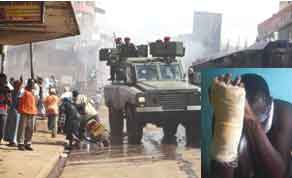
Military police officers patrol a street during demonstrations in Kampala yesterday. At least two persons were killed when police fired live bullets and tear gas to disperse crowds protesting the arrest on Thursday of opposition leader Kizza Besigye. Inset: Besigye at Kasangati police station after he was detained and attacked with teargas by the police at Mulago roundabout in Kampala. Police arrested him on Thursday for the fourth time this month, after smashing his car windows and tear-gassing him
Kizza Besigye, who was defeated by President Yoweri Museveni in a February presidential election, was detained on Thursday for the fourth time this month during a protest against high food and fuel prices.
Television footage showed Besigye being beaten and drenched repeatedly with pepper-spray before he was thrown into a police pickup truck.
He was later released on bail for medical treatment and his lawyer said he could not see.
While the protests against rising living costs have not attracted a huge following, the manner in which Besigye was arrested unleashed a wave of anger in Kampala and at least two other towns in the east African country.
“Kampala will be like this every day until Besigye is safe,” shouted one young man has he ran from military police firing live rounds into the air in Nakasero market.
Besigye made to leave for neighbouring Kenya yesterday afternoon to seek medical treatment.
An official in his party said he was not running away and hoped to be back for a court appearance on Monday if his eyes had recovered.
However, Ugandan security officials prevented Besigye from boarding his plane.
“Plainclothes men have blocked him from leaving. We don’t know why. They are threatening him with arrest if he does not leave (the airport),” said Anne Mugisha, deputy foreign secretary of the opposition party Forum for Democratic Change.
She said the plane Besigye had been due to board left for Nairobi without him.
“I’ve not inquired, but my guess is that he’s on bail from court so that could complicate his travel,” Acting Information Minister Daudi Migereko told Reuters.
Military police fired live rounds, rubber bullets and teargas at burning barricades blocking the main road out of Kampala to the international airport in Entebbe and sprayed adjacent residential areas with bullets.
Shell casings littered the highway, teargas hung in the air and security forces beat local residents.
Reuters witnesses saw burning barricades in at least seven areas of Kampala and there were reports of rioting in other districts.
A Reuters witness saw one victim lying in a pool of blood who appeared to have been shot in the head at a market.
Minister for Internal Affairs Kirunda Kivejinja told a news conference that two people had died in the violence, 90 were injured, 360 arrested and that the authorities were investigating reports of further injuries.
“The police, therefore, within its constitutional mandate restored law and order and removed the blocks from the roads, opened the roads, disengaged the crowds to ensure those with criminal intentions do not reach the city centre,” he said.
Kivejinja also said Besigye and his aides had threatened the police with pepper spray and a hammer, and that the officers who arrested him had used “appropriate force”.
“He and his group in the car had clear intentions to do harm to the police,” the minister said.
Besigye’s February election loss was the third time he had been defeated by his former ally Museveni. He has vowed to continue campaigning despite repeated detentions during protests that had killed at least five people before yesterday’s deaths.
Museveni, in power since 1986, blames drought for high food costs and soaring oil prices for surging local fuel costs, and has warned Besigye that his protests will not be tolerated.
Uganda’s statistics bureau released inflation figures for April yesterday that showed the headline rate had leapt to 14.1% from 11.1%, with food prices up by nearly a third over the past year.
Uganda’s opposition has called the government’s decision to spend $720.6mn on Russian fighter jets a misuse of meagre resources.
In Besigye’s home town of Rukungiri, a heavy deployment of security forces led youths to erect barricades while others fled the streets, residents said.
“There’s immense anger in all Rukungiri because they can’t believe security could treat Besigye like that,” said Collins Nyangaro, a Rukungiri resident.
The Red Cross said two people had been injured in a town on Uganda’s eastern border with Kenya.
“How can they teargas and beat an important man like that when he is telling the truth that we are poor? They spend our money on fighter jets and teargas when people have no food,” shouted an angry protester in Kampala.