


AFP/Abuja/Kano
Nigerians voted yesterday in state governor elections in the last of three landmark ballots this month and after presidential polls set off unrest believed to have killed hundreds last week.

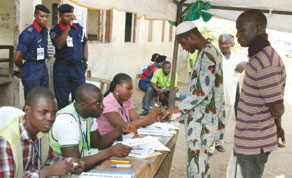
Nigerians vote for state governors at a polling station in Lagos yesterday
Turnout appeared to be down in a number of areas, with reports of some electoral workers refusing to show up out of fears of further attacks and an estimated 74,000 people displaced from last week’s rioting.
Security was tight, with curfews and military patrols having largely restored calm in Africa’s most populous nation, but there were still reports of ballot-box snatching in a number of states.
Three bomb blasts also hit the northeastern city of Maiduguri, an area long plagued by violence blamed on an Islamist sect, but no one was reported wounded. No one was allowed on the streets there except to vote.
Voting wrapped up in several areas in the late afternoon and counting had begun.
Police in the southern oil state of Delta found two bombs, one of them near the offices of the electoral agency. A second one was found at a local government office.
“We found explosives, but they did not explode. Our bomb disposal unit detonated them safely,” said the police commissioner for Delta state Adisa Bolanta.
The bombs were discovered in two towns on the outskirts of the oil city of Warri as the state governorship and assembly elections were under way.
Police spokesman Charles Muka said that “we can’t link them (bombs) to anybody, but it’s possible the target was the election.”
The vote came after April 16 presidential elections led to widespread rioting across the mainly Muslim north of the country, leaving more than 500 dead, according to a local rights group.
Unrest broke out despite what some observers said appeared to be Nigeria’s cleanest vote for head of state since a return to civilian rule in 1999, with the country seeking to break from a history of deeply flawed polls.
The election won by President Goodluck Jonathan exposed deep divisions in Nigeria, particularly between the country’s economically marginalised north and predominately Christian south, home to the oil industry.
Some of those displaced by the riots, many of whom are living at increasingly squalid military and police barracks, expressed fears of voting.
“I can’t risk my life to go and vote,” said Emmanuel Idahosa, a 42-year-old mechanic who has been living at a barracks in the main northern city of Kano.
“We’ve lost our homes, our businesses, our loved ones to post-election violence, and you expect me to stick my neck out for a second time to go and vote?”
Most of Nigeria’s 36 states held governorship and state assembly polls. The ruling Peoples Democratic Party is projected to lose a number of states and many races were expected to be closely fought, raising concerns that desperate politicians may seek to rig.
Some analysts believe that could set off another round of violence, with much of the initial rioting following the presidential election believed to have started over allegations of rigging.
One potential hotspot was the state of Akwa Ibom on the edge of the Niger Delta region, where opposition members were arrested in the run up to the vote.
Polling stations opened some two hours late in certain areas there, while there were also reports of ballot-box theft, as was the case in a number of other states.
Nigeria’s state governors wield significant power and preside over large budgets thanks to revenue generated by the oil industry. The ruling party currently controls some 27 state governorships, but it faces tough challenges.
In the southwest, the Action Congress of Nigeria opposition, in power in the economic capital Lagos, was looking to gain more ground.
The Congress for Progressive Change, the party of ex-military ruler Muhammadu Buhari, Jonathan’s main challenger in the presidential vote, appeared set to make gains in the north.
Jonathan, a southern Christian, defeated Buhari, a Muslim from the north, by a score of 57% to 31% in the presidential vote. There were allegations of rigging in the north over the presidential vote, including from Buhari himself, though observers hailed the election as a major step forward.
A new voter list was compiled with the use of electronic fingerprinting and various safeguards were in place in an effort to prevent rigging and ballot-box snatching.
Observers note that serious problems remain, but say the parliamentary elections on April 9 - which had to be postponed from April 2 - and the presidential vote constituted significant improvements.
Not all states were voting yesterday. Kaduna and Bauchi states will hold their state elections tomorrow due to deadly unrest there. A total of 26 states, including Kaduna and Bauchi, will hold governorship ballots this week, while all 36 will hold state assembly polls.
The other 10 states will not hold governorship ballots at this time because of court cases over previous election results that delayed the start of governors’ terms of office.