


AFP/Berlin
German Chancellor Angela Merkel’s ailing junior coalition partners sought a fresh start yesterday after Foreign Minister Guido Westerwelle quit as party leader following 10 years at the helm.

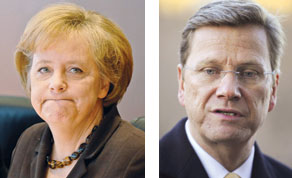
Merkel and Westerwelle
Reports said yesterday that Westerwelle’s stepping down as head of the Free Democrats (FDP) in May would also mean he would quit as deputy chancellor.
Merkel’s spokesman said it was up to the party to decide.
Commentators questioned whether he should remain Germany’s top diplomat as he intends.
“It is an exceptional day for me personally but I am sure that it is the right decision, also to ensure a generational change in the FDP,” Westerwelle said late on Sunday in Berlin.
Merkel said that Westerwelle’s departure was a “turning point for the (FDP) ... but the work of the CDU-FDP coalition will continue”, referring to her conservative Christian Democrats.
Westerwelle’s announcement followed a string of dismal state election results for Merkel’s governing coalition in recent weeks.
The FDP failed to win seats in parliament in two of the elections and only just managed to do so in a third. A poll released on Friday showed that 69% of voters put the blame squarely on Westerwelle.
In national surveys the pro-business party is on around 5%, the minimum for seats in parliament, down from the 14.6% in federal elections in September 2009.
That election result allowed Merkel, 56, to ditch the unwieldy alliance of her first term with the centre-left Social Democrats (SPD) and form a coalition with Westerwelle’s FDP instead.
But the “dream coalition” has been anything but, with pre-election promises of tax cuts unfulfilled and the parties descending into public squabbling and name-calling over everything from healthcare reforms to energy policy.
An election defeat in North Rhine-Westphalia state last May lost the governing coalition its majority in the federal upper house.
In February the CDU lost power in Hamburg after 10 years in charge and on March 27 it ceded the southern state of Baden-Wuerttemberg, where Merkel’s party had ruled for 58 years – longer than she has been alive.
Although the sharp-tongued Westerwelle had shepherded the FDP back into government after 11 years out of power, critics said his skills were better suited to sniping from the opposition benches than serving in office.
Westerwelle, once seen as the “joker” of German politics before achieving the FDP’s best-ever election result in 2009, is also post-war Germany’s most unpopular foreign minister, according to polls.
Opponents say he lacks the finesse, curiosity and nuance for the job. US diplomats quoted by WikiLeaks portrayed him as an incompetent and vain lightweight.
The conservative Frankfurter Allgemeine Zeitung questioned whether “a former, effectively toppled party leader” should still represent Germany’s interests abroad.
“In political terms this would serve no one: not the country, not the government and not even the FDP,” agreed the Handelsblatt business daily.
FDP general secretary Christian Lindner said however that remaining foreign minister was the “correct step, ensuring continuity”.
Widely tipped to succeed Westerwelle, at least as party chairman, is Health Minister Philipp Roesler, 38.
Another possible head is Lindner, 32. Candidates are due to declare themselves at party meetings today.
“Merkel is going to have to distance herself from the FDP, even if they are her partners, because they are in a position of weakness,” political scientist Gero Neugebauer of Berlin’s Free University told AFP.