


AFP/Abidjan
 |
|
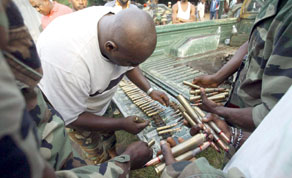
Forces loyal to Ouattara reload weapons on the back of a pick-up truck in Abidjan |
Cornered, but clinging on, strongman Laurent Gbagbo brushed off calls by world leaders to step down amid an offensive by troops backing the internationally recognised president Alassane Ouattara in Abidjan.
Reports of carnage, meanwhile, emerged from the western town of Duekoue where the International Red Cross said 800 died and the UN mission accuses fighters from both camps of mass killings.
Gbagbo has been holed up in the presidential palace and residence in Abidjan’s chic Cocody district, where several embassies are located.
Walls shook as mortar and other heavy arms fire broke out at 1215 GMT near the presidential palace, AFP journalists said.
Ouattara’s government declared a curfew from midnight yesterday until 6am today.
While Gbagbo’s camp claimed to have pushed back an assault on Friday, Ouattara’s fighters warned that the offensive “has not yet begun”.
“We are taking steps to weaken the enemy before mounting an assault,” said Captain Leon Kouakou Alla, spokesman for Ouattara’s defence ministry.
Weary with failed diplomatic efforts to resolve a post-election crisis, Ouattara’s army on Monday launched a lightning offensive across the country before arriving in Abidjan on Thursday.
Fierce fighting accompanied by loud explosions and bursts of machine gunfire sent residents of the city of 5mn people into lockdown, and some 1,400 foreigners sought refuge at a French military camp.
State television RTI, briefly captured by Ouattara’s army, was back on air yesterday.
In a brief, haphazard newscast, a soldier, accompanied by a dozen other members of Gbagbo’s Defence and Security Forces (FDS), read a statement urging “all the staff of the armed forces” to join five units located in the main city, Abidjan.
The broadcast was followed by images of angry soldiers.
In one scene they are seen prodding the bodies of two men killed near the television station on Friday.
As the violence escalated in the world’s top cocoa producer, both camps have been accused of atrocities that could be considered crimes against humanity.
Hundreds of bodies were discovered in the wake of a fierce battle for the town of Duekoue in the west, with accusations flying as to who is responsible.
The UN mission in Ivory Coast reported “330 people killed between Monday and Wednesday ... the majority were executed by ‘dozos’”, said Guillaume N’gefa of the UNOCI human rights division, referring to traditional hunters fighting in Ouattara’s army.
He said over a hundred in the town were killed by pro-Gbagbo forces before the fighting started.
However Ouattara’s government reported numerous mass graves had been found, “especially in Toulepleu, Blolequin and Guiglo, whose authors are none other than the loyal forces, mercenaries and militias of Laurent Gbagbo”.
International Committee of the Red Cross (ICRC) spokeswoman in Geneva, Dorothea Krimitsas, told AFP information gathered by Red Cross workers showed “at least 800 people were killed in Duekoue on Tuesday” in what appeared to be inter ethnic violence.
“There is no doubt that something on a large scale took place in this city, on which the ICRC is continuing to gather information,” she said, adding that Red Cross workers had “themselves seen a very large number of bodies”.
Human Rights Watch said yesterday that while the vast majority of abuses have been by Gbagbo forces against supporters of his rival, Ouattara should rein in his troops, ensuring that they “do not commit reprisals or other abuses against civilians or supporters of Laurent Gbagbo”.
Ouattara’s government said it “firmly rejects such accusations and denies any involvement” of his army in possible abuses.
Several hundred people have been killed in the aftermath of the presidential election in November, and the UN estimates a million people have fled Abidjan in recent weeks fearing a bloodbath.
Former colonial master France, which has 12,200 nationals in Ivory Coast, urged Gbagbo to quit power as did the United States, the European Union, the African Union and the United Nations.
UN chief Ban Ki-moon said that “there has been too much bloodshed” already in the conflict.