


Reuters/Abidjan
 |
|
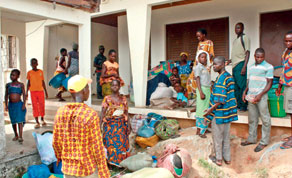
Ivorians displaced due to battles between pro-Outtara forces and soldiers loyal to Laurent Gbagbo stand near a school in Blolequin in western Ivory Coast |
In a sign of how bloody the West African state’s post-election conflict has become, forces loyal to Ouattara’s rival, incumbent leader Laurent Gbagbo, opened fire on civilians in Abidjan yesterday, killing about 10, the UN peacekeeping mission said in a statement. Gbagbo’s camp was not immediately available for comment.
Witnesses and fighters from both sides of the conflict said yesterday that the former rebels, who have controlled northern Ivory Coast since the civil war of 2002-3, had seized the western town of Daloa from Gbagbo’s troops.
They also took Duekoue, further to the west. Both towns potentially open up a route to the major exporting port of San Pedro and the area they now control produces about 600,000 tonnes of cocoa a year, half of Ivory Coast’s output.
San Pedro ships out about that amount each year.
In an escalation of fighting that had previously been limited to Abidjan and the far west, pro-Ouattara forces have also made progress in the far east of the country, marching south near the Ghana border.
A violent dispute over last November’s presidential election that UN-certified results showed Ouattara won, but which Gbagbo refuses to concede, has rekindled the civil war it was meant to finally end. Heavy fighting has rocked Abidjan and across much of a north-south ceasefire line.
Up to 1mn Ivorians have now fled fighting from the main city of Abidjan alone, according to the UN refugee agency. Others have been uprooted across the country and at least 112,000 have crossed into Liberia to the west.
A source in the pro-Gbagbo military said Daloa and Duekoue had fallen, but fighting continued in parts of Duekoue. “The combat was very violent in Daloa the whole night, but we couldn’t keep our positions ... It has fallen into rebel hands.”
The former rebels, now part of the FRCI, the officially recognised Ivorian army, also seized Bondoukou in the east, near the Ghana border, and pushed south, reaching the town of Agnibilekrou unhindered, witnesses said.
The UN peacekeeping mission complained that FRCI fighters in Duekoue had fired on one of its reconnaissance helicopters. They have been targeted by Gbabgo’s forces, never by Ouattara’s.
Daloa is sympathetic to Ouattara and Duekoue is mixed, yet many of the areas surrounding them are hostile and teeming with pro-Gbabgo militias, which could make the march south tough.
Still, the new fronts have moved quickly, so far. “These places seem to be falling quickly. You would have thought they had better forces, fighters that wouldn’t give up,” said a diplomat following the situation.
Unlike the last war, when French peacekeepers stepped in at Duekoue to stop the rebels advancing on San Pedro, world powers are this time furious with Gbabgo for torpedoing the peace process by rejecting the election results. All recognise Ouattara as president and diplomats say they are therefore unlikely to hinder the former rebels’ advance.
“The rebels are patrolling everywhere in pick-ups,” said Daloa resident and cocoa farmer Abdoulaye Timite. “No farmer is going out to tend the plantations. They ransacked the local Gbagbo party office. They were applauded by the population.”
Fear gripped the town of Bouafle as residents anticipated the rebels advancing east towards the capital, Yamoussoukro. “After the new attack on Daloa, lots of people are scared and are leaving Bouafle,” said Abi Cissokon, a resident.
“Lots of shops have closed today. We don’t see any gendarmes in town. Some people are heading to bus station with their bags,” Cissokon added.
Ouattara remains holed up in a lagoon-side Abidjan hotel.
The UN report of more civilians killed adds to a tally of 462 confirmed deaths since the crisis begin. Rights groups say crimes against humanity may have already been committed.
The world body is also investigating allegations that 200 African nationals - from Mali, Burkina Faso, Senegal, Guinea and Togo - were killed near Guiglo, southwest of Duekoue.
State television has been whipping up hatred by accusing West African foreigners of being behind the rebellion.