


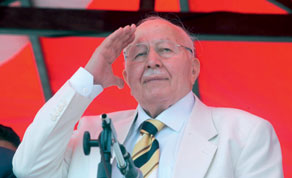
AFP/
Erbakan: mentor of Erdogan
Necmettin Erbakan, the mentor of political Islam in secular

“
The chief physician of the
“There was an abrupt disorder in his heart rhythm... We failed to get any result despite all treatment,” the doctor said in televised remarks.
Prime Minister Recep Tayyip Erdogan immediately issued a message of condolences over the death of a man who was his mentor but later become a political rival.
“He set a good example as a teacher and leader for young generations with his personality, his struggle and principles,” Erdogan said.
“We will always remember him with gratitude for what he taught us and for his persevering character,” he said.
Erbakan, who headed the small Islamist Felicity Party, had looked increasing frail in recent years and often used a wheelchair.
He became secular
But he was forced to resign a year later as a result of a harsh secularist campaign led by the powerful army concerned over threats to
The campaign came after his party’s moves to raise the profile of Islam in social life and to seek closer ties with Islamic states such as
In 1998, the constitutional court outlawed his Welfare Party for anti-secular activities and banned Erbakan from politics for five years, which eventually led to a split in his movement, with moderates, led by Erdogan, breaking ranks with their mentor.
In 2001, Erdogan set up the conservative Justice and Development Party (AKP), which disowned its Islamist past and pledged to respect secularism.
The AKP came to power in 2002 and Erdogan became prime minister the following year, leading his party to a second election victory in 2007, with Erbakan’s movement failing to even enter parliament.
In 2002, Erbakan was sentenced to two-and-a-half years in prison for embezzlement of party funds. But he managed to postpone the sentence on health grounds and was eventually pardoned in 2008 while under house arrest – by President Abdullah Gul, another former associate.
Despite his plump and genial-looking exterior, Erbakan was a fierce ideologue and tough political survivor who tirelessly spread his Islamist and anti-Western messages.
Nicknamed “Hoca” (Master), Erbakan was born on October 29, 1926.
In 1948, he earned a degree in mechanical engineering and pursued an academic career that took him to Germany, where he later worked in Deutz factories on projects for the German army.
Erbakan entered politics in 1969, creating the pro-Islamic National Order party, which was banned in 1971.
He then founded the pro-Islamic National Salvation Party, which won 12% of the vote and several dozen parliamentary seats in 1973.
He served as deputy prime minister in three coalition governments in the 1970s, marked by Turkey’s occupation of northern Cyprus and bloody street clashes between leftist and nationalist militants, which prompted a military coup in 1980.
The coup led to Erbakan – and many others – being barred from politics.
The ban was lifted in 1987, paving the way for him to become head of the Welfare Party, which he created in July 1983.
In Turkey’s December 1995 elections, Welfare received 21% of the vote and became the largest political group in parliament.
Erbakan allied with former prime minister Tansu Ciller in June 1996 to set up Turkey’s first Islamist-led government.