


Reuters/
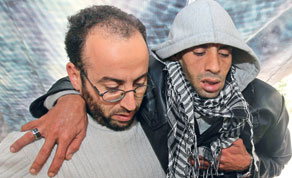
An immigrant who is on hunger strike is held up by a supporter in the yard of a building in central Athens yesterday
The European Union yesterday offered

It put no figure on the funds offered.
According to EU estimates some 5,500 Tunisians have reached Italy in recent days, escaping turmoil in the aftermath of protests that led to the overthrow of President Zine al-Abidine Ben Ali on January 14. The flow of migrants has sparked a diplomatic row between Italy and Tunisia and has led Rome to ask for EU assistance.
“We are ready to assist both Italy and Tunisia. This is a matter of great importance for the EU,” Commissioner for Home Affairs Cecilia Malmstrom said in a speech.
Malmstrom said the number of people reaching Italy, who are mostly men in their 30s, has “reportedly” dropped in the last 24 hours.
She said the EU could allocate emergency cash to help Italy pay for accommodation, medical care, social assistance and counselling for migrants, and send officers to help process asylum requests.
The EU could also send a team from its border control agency Frontex to help with border surveillance.
Malmstrom also urged the Tunisian authorities to bolster border patrols to “prevent smugglers, human traffickers, and criminals escaped from prisons to take advantage of the situation”.
“It is also important that Tunisia accept taking back those who have reached the territory of EU member states without being in need of international protection,” she said.
The EU foreign policy chief, Catherine Ashton, said she was seeking at least 2.5bn euros ($3.4bn) to help Tunisia, Egypt and other North African states. This would include 1bn euros of European Investment Bank lending to Tunisia alone.
Three illegal immigrants taking part in a mass hunger strike in Greece have been admitted to hospital, doctors and supporters said yesterday.
One striker, camped out in a residence in central Athens, was treated in hospital for heart problems, doctor Thanassis Karabellis told reporters.
He added that eight others taking part in the protest have given up and warned that strikers had shed up to 12kg since they began refusing food three weeks ago.
In northern Thessaloniki, two Moroccans were hospitalised after a series of fainting fits, their supporters said.
The group of 287 illegal immigrants, mostly North African men, began the strike on January 25 across Greece, demanding that their status be legalised and saying they would continue their efforts until their demands were met.
More than 100 leftist organisations, both domestic and foreign, are supporting the migrants including the Spanish Communist party, French group Solidaires and the US network Znet.
The government has refused their demand, although it has said it would re-examine the issue after some 150,000 legal migrants claimed they lost their status after becoming unemployed.
Under Greek law, residence permits are linked to tax payments.
France has said it would let Tunisian migrants who have fled to Italy after a political uprising in their homeland to seek refuge on French soil only in a few “very marginal” cases.