


Reuters/
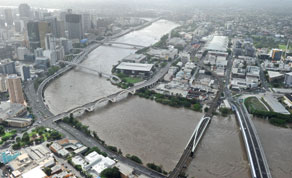
The swollen Brisbane river snakes around the Brisbane, Australia, central business district
Massive floods shut down the centre of

Australia’s biggest floods in a century have so far killed 16 people since starting their onslaught across northern mining state Queensland last month, crippling the coking coal industry, destroying infrastructure, putting a brake on the economy and sending the local currency to four-week lows.
The flood surge is expected to peak in
“We are in the grip of a very serious natural disaster,”
“
The flood peak hit
Ipswich Mayor Paul Pisasale said the flood peaked at 19.4m, about a metre below expectations, saving some 6,000 homes from flooding. “It’s the difference between bad news and devastation,” he said.
At flooded intersections people paddled surfboards through floodwaters, balancing their possessions on the deck of the boards, while boats ferried evacuees to dry ground.
“I am feeling a sense of horror and awe at the power of the river. Sadly in coming hours we will see bits of people’s homes float down the river,” Brisbane Mayor Campbell Newman said, warning the torrent could take three to four days to subside.
Four thousands people sheltered in evacuation centres.
Economists have raised their estimates of the economic impact of the flooding, with one central bank board member saying on Wednesday the disaster could cut 1% off growth - equal to almost $13bn, double the previous highest estimate.
The Australian dollar sank to a fresh four-week low of $0.9803 on the comments from Warwick McKibbin, an academic and a member of the central bank’s policymaking board.
Treasurer Wayne Swan in November forecast GDP growth of 3.25% in the 2010-11 fiscal year, up from a 3.0% projection, but said spending would be cut to ensure a surplus of A$3.1bn or 0.2% of GDP in 2012/13.
“The coal industry will take several weeks and in some cases months to get back to full production,” Bligh said.
Food prices are surging around the country as the floods ruin
Rescue crews took advantage of some rare sunshine to look for 43 people still missing from tsunami-like flash floods that tore through townships west of the city this week.
“Some of the houses have exploded with the force of the water. People have been washed away. It will take days to complete this search and recovery,” said Deputy Police Commissioner Ian Stewart.
In
“If you start to see water in your yard, get out. Take your family and get to safety. This water could rise very, very quickly,” said state premier Bligh.
Some
“This is my whole life, everything is gone. I never thought it would get this bad,” said Kim Hung, manager of the Salt ‘n’ Pepper catering business, as two friends floated a coffee machine toward higher ground.
As the waters rose strangers formed human chains, sometimes in chest high water, to pass family possessions from flooded homes to dry land and into cars and trucks and safety.
Raw sewage began spilling into the river and creeks, prompting authorities to warn of heightened disease risk as spillage from damaged treatment works polluted the floodwaters.
Dams built to protect
Power company Energex shut power to some low-lying areas of Brisbane, including parts of the financial district, for fear that live power lines could electrify floodwaters. Some 78,000 homes in the southeast of Queensland were without electricity.
Prime Minister Julia Gillard arrived in Brisbane to inspect the devastation and said she was deeply concerned about the impact on jobs and livelihoods.
“I have been shocked. I think we’ve all been shocked by the images of that wall of water just wreaking such devastation. The dimensions of it are truly mind-boggling,” Gillard said.
The floods have been blamed on a La Nina weather pattern in the Pacific, with Australia recording its third-wettest year on record in 2010, with two wet-season months to go. Weather officials are forecasting an above-average cyclone season, while scientists said climate change is likely to have intensified the monsoon rains behind the floods. As the Queensland floods and rains move south, major rivers in New South Wales state have begun flooding or threatening to break their banks, forcing 3,000 people to leave some rural areas. In Victoria state in the southeast, heavy rain caused flash flooding and landslides, prompting fears a lake near Horsham could break its banks.