


AFP/
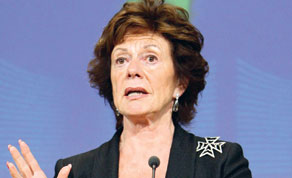
Kroes: examining the law
The European Commission raised fresh concerns yesterday about

The European Union’s executive arm has launched a review of the disputed legislation, which has marred
In remarks to the European Parliament, European digital agenda commissioner Neelie Kroes said the law seems to “raise a problem” because its provisions would apply to news organisations from other European nations.
The legislation’s requirement of balanced reporting also poses a problem because it appears “to be quite wide”, extending from traditional broadcasting to “a simple video blogger”, she said.
Until now the European Commission had only voiced concerns about the independence of the national media watchdog, which is solely composed of figures close to the party of Prime Minister Viktor Orban.
The media law allows the new regulatory body – headed by a close ally of Orban – to impose major fines on media outlets and force journalists to reveal sources on issues related to national security.
“The new media law raises broader political questions concerning freedom of expression,” Kroes said.
“Freedom of expression constitutes one of the essential foundations of our democratic societies, recognised in the European treaties and in the EU charter of fundamental rights,” she said.
“I am fully confident that
Orban has hit out at French and German criticism of the law, but said last week that
Kroes said the commission was “very carefully” examining the provisions of the media law.
“As soon as we receive the official notification of the law, which should happen this week, we are going to make our legal assessment of the Law, in full objectivity,” she said.
Hungarian officials complained they were not invited to express their views at the EU Parliament debate yesterday even though Hungarian experts on press freedom took part.
“Hungary asked to be invited to the meeting and learned yesterday that it was authorised to watch the debate from the public sitting area but not to take part in the panel discussion,” said Hungarian embassy spokesman Gergely Polner.
“This raises questions about the independence of this meeting,” he told AFP.