


AFP/
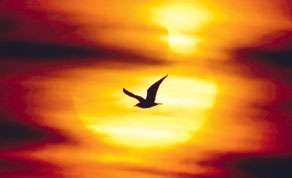
A seagull is silhouetted against the sun at dawn during a partial solar eclipse on Guadalmar beach in
Europe

In
“Aaah so much hype of an eclipse ... all I saw was the usual British cloud!!!” said Twitter contributor Romana Alli in
Sweden, especially the north of the country, had been predicted to be one of the best places to see the natural phenomenon, with the Sun being eclipsed by more than 80% in some areas, according to Goeran Olofsson, a professor of astronomy at the Stockholm observatory.
But astronomy blogs reported that northern areas were also hit by cloud.
In the Swedish capital, however, there was a better view.
Rising over
“This was actually the best partial solar eclipse I have seen. Talk about drama. What a spectrum. It was brilliant,” Nils Erik Olsson, head of
“We were maximally lucky.... That there were clouds around the Sun in the beginning only increased the drama,” he said.
“The Sun looks like a brightly shining moon crescent,” added Bjoern Haglund in
In
Yesterday’s partial eclipse occurred when a fraction of the Moon obscured the Sun, making it seem – in clear skies – as if a bite had been taken out of the solar face.
Star-gazers enjoyed the spectacle in southern
In
In the
Clouds and falling snow masked views of the eclipse for most residents of
In
Eclipse-watchers have had an unusually bumper year, according to Nasa, which counts two partial solar and two total eclipses in 2011.
The next partial solar eclipse will be on June 1, visible in parts of eastern
Total solar eclipses occur when the Sun, Moon and Earth are all perfectly in line.
The Sun is 400 times wider than the Moon, but it is also 400 times farther away, which means the lunar shadow, or umbra, is just wide enough to cover the face of the Sun.
The last total solar eclipse was on
The next will be on