


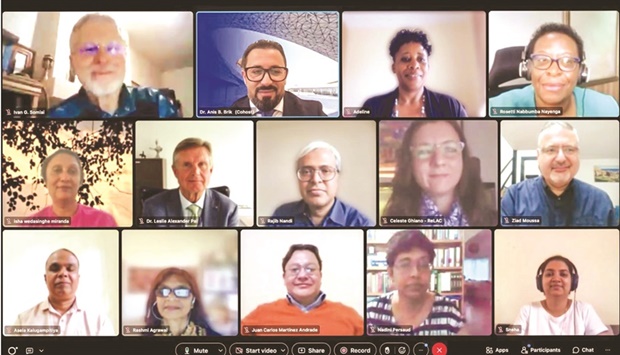
The College of Public Policy (CPP) at Hamad Bin Khalifa University (HBKU) held its inaugural research conference, “Evaluation in the Global South: Looking to the Future”, on November 7-8.
Featuring more than 50 speakers from over 30 countries and 16 partners, the conference sought to provide an interdisciplinary audience with cross-country learning to enable them to better understand evaluation in different nations and different sectors across the global south.
More than 200 participants joined in the discussions over the two days.
The conference was organised by the Programme for Social Policy Evaluation and Research (Prosper) at the CPP, in partnership with leading international, regional, and national evaluation organisations and UN agencies.
Prosper is an initiative founded by CPP associate professor Dr Anis Ben Brik with a research agenda driven by the grand social policy and evaluation challenges in Qatar, countries in the Middle East and North Africa (Mena) and the global south.
Aiming to be one of the first conferences of its kind to go beyond Western-centric appraisals and present a truly global south portrait of evaluation research and practice, interdisciplinary researchers, academics, professionals, and students reflected on the most current research.
Case studies of evaluation in Africa, Asia, Latin America, the Caribbean, and the Mena regions highlighted challenges and opportunities for evaluation research and practices.
These included the post-coronavirus (Covid-19) pandemic recovery, evaluation skills and capacity building, evaluation in conflict settings, and on climate change adaptation, participatory approaches, and linking evaluation to the UN Sustainable Development Goals (SDGs).
Sessions provided up-to-date evidence-based theorising about practicing evaluation amid the challenges.
Discussions identified the strengths and weaknesses of the most promising evaluation approaches to help determine when methods are likely to be most effective.
They also looked to the future, focusing on Strengthening the Southern Voice – Elevating the Knowledge and Influence of the Global South, Decolonising Evaluation Teaching and Learning/Capacity Development, and Youth in the Evaluation Movement.
The conference concluded with the launch of a manifesto to meaningfully engage young people in evaluation research.
Commenting at the end of the event, Dr Ben Brik said: “Our inaugural conference successfully amplified the voices of leading evaluation scholars from the global south, enabling a better collective understanding of challenges and opportunities for different nations and different sectors.”
“The conference highlighted the value that a much more robust focus on South-South co-operation can add to the advancement of evaluation as practice and research in service of the Global South,” he said. “Ahead of future editions of the conference, the work of Prosper will continue focusing on disseminating the findings, encouraging collaboration, and strengthening capacities and systems for evaluation through our education and research programmes.”
800628