


Cobbling together $5.5bn of financing for a leveraged buyout is trickier than ever given Wall Street’s reduced risk appetite. Just ask Blackstone Inc.
When the buyout firm set its eyes on a unit of Emerson Electric Co, market conditions were bleak and getting bleaker by the day. Banks in the US and Europe were already staring at billions of dollars of losses on debt they had agreed to provide for acquisitions.
In the end, Blackstone bypassed investment banks and put together the final piece of the puzzle by turning to private credit firms. The purchase of Emerson’s climate technologies arm, announced on last Monday, shows the financial gymnastics now required to fund buyouts. It also highlights that private lenders still have an appetite to lend at scale when deals involve low leverage, strong businesses and buyout shops writing larger equity checks.
After engaging with Emerson for the better part of a year on a sale of its air conditioning and refrigeration unit, Blackstone executives realised they needed to toss out the standard playbook if they wanted to get a deal done. Before approaching lenders, they lined up $2bn of preferred equity and $2.25bn of so-called seller financing from Emerson to make lenders more comfortable, people with knowledge of the matter said.
As long as a group of Wall Street heavyweights could come up with $5.5bn, a deal was within reach. But after the Labor Day holiday, sentiment soured even further as a large group of banks crystallised hundreds of millions of losses on the buyout of Citrix Systems Inc.
Several lenders that had discussed financing the Emerson deal offered to participate only if they could underwrite the debt at around 85 cents on the dollar, an offer Blackstone promptly rejected, the people said. Others who were more constructive were only willing to underwrite a small portion of the transaction.
“It became clear that the $60bn or so on banks’ balance sheets wasn’t clearing, and so therefore it was harder to do bank underwriting,” Joe Baratta, Blackstone’s global head of private equity, said in an interview. “By mid-September, it became clear that route wasn’t viable at all.”
That’s when the four-person team led by Blackstone’s head of capital markets, Jonathan Kaufman, decided to look elsewhere. Instead of relying on banks for the entire $5.5bn financing, Blackstone started canvassing private credit investors, which had become accustomed to funding multibillion-dollar transactions. Although those lenders have also dialled back risk, Blackstone ultimately found enough demand to place $2.6bn of the debt with a group of private lenders, the people said.
A group of commercial banks led by Royal Bank of Canada ended up providing the remaining $2.9bn through a so-called term loan A, a kind of loan that amortises over time and is less costly for banks to carry on their balance sheet compared to typical bridge loans for leveraged buyouts.
Commercial banks and private lenders are cut from different cloth.
While both expect to hold the debt to maturity, private lenders are looking for higher yields, but are able to accept longer-dated debt. Banks, meanwhile, look for amortisation, meaning they are repaid periodically not just on the interest of the loan - like the direct lenders - but also on the principal.
Bank lenders took term loan As at a margin of 4.50 percentage points over the Secured Overnight Financing Rate, according to two of the people. The $2.6bn underwritten by direct lenders pays a margin of 6.75 percentage points over the benchmark rate, they said.
While both instruments have the same level of seniority in the company’s capital structure, the bank piece matures in five years instead of seven, and it includes a step up in interest rate starting in year three, according to the people. The bank loan also was issued at a steeper discount to face value and also includes a so-called maintenance covenant that requires the company to keep its debt-to-earnings ratio under a specified threshold, they said.
Blackstone, along with co-investors the Abu Dhabi Investment Authority and GIC, will take a 55% stake in the Emerson unit, valuing the business at $14bn at a multiple of 12.7 times earnings. Emerson is hanging on to the rest.
The deal is a rare bright spot for the buyout industry, which has seen its investment pace slow after a banner year in 2021. Through the first 10 months of 2022, private-equity firms globally have struck deals worth $584bn, on track to fall well shy of the near $1tn of acquisitions made last year, Dealogic Inc data shows.
The deal was also helped by the flexibility of the situation, with no auction process, the people said, or hard deadlines and multiple bidders.
The final structure allows Blackstone plenty of flexibility, should credit conditions improve. The bank piece can be refinanced with no penalty and Blackstone may even be able to source alternative capital to replace it before the acquisition is scheduled to close, one of the people said.
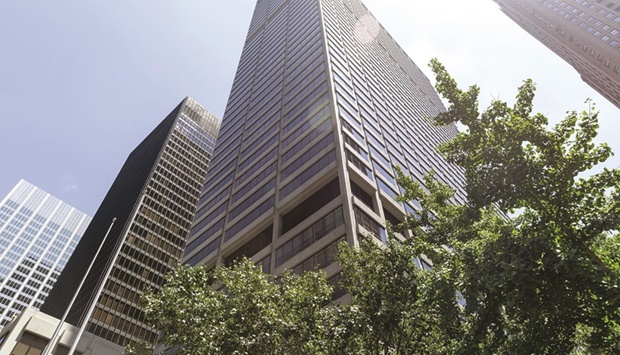
The Blackstone Group headquarters in New York. After engaging with Emerson for the better part of a year on a sale of its air conditioning and refrigeration unit, Blackstone executives realised they needed to toss out the standard playbook if they wanted to get a deal done. Before approaching lenders, they lined up $2bn of preferred equity and $2.25bn of so-called seller financing from Emerson to make lenders more comfortable.