


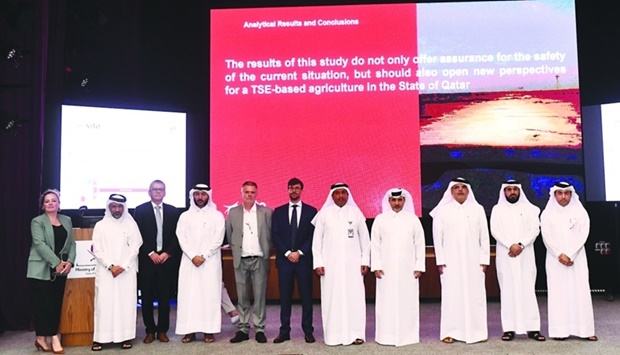
In a statement on the sidelines of the press conference Tuesday to announce the results of a study on "The safe use of treated wastewater in irrigated fodder and its impact on dairy and meat in Qatar," which is conducted by the Agricultural Research Department of the Ministry of Municipality, in cooperation with the Belgian Sustainability Research Centre (VITO), HE the Minister expressed satisfaction with the results of this four-year study, which tested thousands of samples that proved the correctness and safety of using treated water in Qatar, which was taken from different regions and multiple sources before and during treatment processing cycle and during use.
He reassured everyone of these promising results, adding that experts described treated wastewater in Qatar not as "treated water" but as "surface water" due to its proven purity.
The Director of the Agricultural Research Department, Hamad Saket al-Shammari, pointed to the importance of such a study in strengthening responsibility and joining efforts with the private sector to find appropriate solutions and address the issues facing the country and the increasing challenges the world is witnessing in terms of food security in the aspect related to water scarcity and climate change, in addition to identifying priorities and appropriate options to promote and build sustainable food systems to achieve the sustainable development goals.
He noted that finding appropriate solutions to the challenges faced by societies and countries today in achieving sustainable development and food security can only be achieved by co-ordinating efforts, developing policies and plans based on studied scientific foundations, exchanging experiences and exploiting all possibilities, noting that the Ministry of Municipality's agricultural sector (including livestock and fisheries) has an important responsibility to achieve sustainability and food security and to raise the level of self-sufficiency.
VITO CEO Middle East, Arnoud Lust, which is affiliated with the Belgian Sustainability Research Centre (VITO), which conducted the study, said that this project is a milestone for expanding the use of treated wastewater for irrigation in Qatar, which is an essential resource given the country's dry climate and water scarcity associated with it, reviewing the summary of the results that were based on three pillars represented in taking scientifically safe samples for all matrices that can affect the quality of milk and meat products, the samples included: treated and untreated wastewater, sludge from irrigation water reception ponds, soil, fodder, feed additives, and pesticides from sites where fodder cultivation is practiced with treated wastewater from North and West Doha for domestic wastewater treatment plants.
He also stated that samples of animal organs (kidneys and livers), blood and milk were taken, which may contain accumulated pollutants, all of them conducted independent chemical and microbiological analyses for specific analytical parameters, and up to 17,000 analyses were conducted for more than 800 samples in accredited external laboratories in Belgium and Qatar with regard to immediate analyses.
Lust said that the results of this study indicate that there is no evidence of negative effects due to the use of treated wastewater, whether in milk or tissue samples taken from slaughtered animals, and no evidence of a possible accumulation of pollutants in soil or feed crops.
He reassured everyone of these promising results, adding that experts described treated wastewater in Qatar not as "treated water" but as "surface water" due to its proven purity.
The Director of the Agricultural Research Department, Hamad Saket al-Shammari, pointed to the importance of such a study in strengthening responsibility and joining efforts with the private sector to find appropriate solutions and address the issues facing the country and the increasing challenges the world is witnessing in terms of food security in the aspect related to water scarcity and climate change, in addition to identifying priorities and appropriate options to promote and build sustainable food systems to achieve the sustainable development goals.
He noted that finding appropriate solutions to the challenges faced by societies and countries today in achieving sustainable development and food security can only be achieved by co-ordinating efforts, developing policies and plans based on studied scientific foundations, exchanging experiences and exploiting all possibilities, noting that the Ministry of Municipality's agricultural sector (including livestock and fisheries) has an important responsibility to achieve sustainability and food security and to raise the level of self-sufficiency.
VITO CEO Middle East, Arnoud Lust, which is affiliated with the Belgian Sustainability Research Centre (VITO), which conducted the study, said that this project is a milestone for expanding the use of treated wastewater for irrigation in Qatar, which is an essential resource given the country's dry climate and water scarcity associated with it, reviewing the summary of the results that were based on three pillars represented in taking scientifically safe samples for all matrices that can affect the quality of milk and meat products, the samples included: treated and untreated wastewater, sludge from irrigation water reception ponds, soil, fodder, feed additives, and pesticides from sites where fodder cultivation is practiced with treated wastewater from North and West Doha for domestic wastewater treatment plants.
He also stated that samples of animal organs (kidneys and livers), blood and milk were taken, which may contain accumulated pollutants, all of them conducted independent chemical and microbiological analyses for specific analytical parameters, and up to 17,000 analyses were conducted for more than 800 samples in accredited external laboratories in Belgium and Qatar with regard to immediate analyses.
Lust said that the results of this study indicate that there is no evidence of negative effects due to the use of treated wastewater, whether in milk or tissue samples taken from slaughtered animals, and no evidence of a possible accumulation of pollutants in soil or feed crops.