


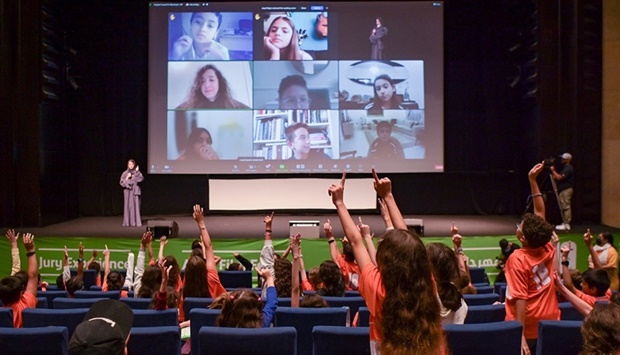
“Who is Syria at war, and why are they fighting,” asked a young Ajyal Juror at the Special Edition of the 10th Ajyal Film Festival, leading to an engaging, often emotional, discussion about the futility of the wars waged by adults with children often suffering the most severe consequences, as they are denied of their childhood, have to endure the loss of loved ones, and often having to live in refugee camps.
The trigger to the innocent questions about war and strife in the region was the screening of Dounia & The Princess of Aleppo (Canada, France/2022), directed by Marya Zarif and André Kadi.

The animated feature is about six-year-old Dounia, whose journalist father is taken away by uniformed soldiers one night, turning her life upside down.
As bombs rain down around them, the family members decide to flee with only a few possessions, and a little magic in hand.
Dounia’s more traumatic encounters are eased in child-like flights of imagination thanks to her magic baraki seeds.
Answering the “tough” questions from the youngest of the Ajyal jurors (Mohaq, aged 8-12), director Marya displayed an astute understanding of their sensitivities, saying that “wars happen because human beings are sometimes too stubborn and refuse to understand that living in peace and harmony is more important than being right or wrong”.
She said that her film, however, was inspired not as much by tragedy as by the hope and cheer she saw in the faces of Syrian children, who had lost everything, but were finding joy in the little things.
“Despite losing their homes and loved ones, despite living in camps, I saw in them abundant strength,” Marya said. “I got inspired to create a film for them and create a character that is truly reflective of them, which is Dounia, even when life is hard.”
The director, who now lives in Canada, also said that many elements in the film are similar to her own life.
Young jurors also watched Comedy Queen (Sweden/2021) by Sanna Lenken, about Sasha, a teenager, who wants nothing more than to become a stand-up comedian.
There is so much grief within though, as she refuses to mourn her mother, who passed away in tragic circumstances.

Instead, she secretly writes a list of everything she must do to survive – shave her hair, stop reading books, say no to the world’s cutest puppy and above all – become a Comedy Queen.
This allows her to finally come to terms with her loss and re-establish a relationship with her father in this touching coming-of-age drama.
The Hilal jurors, aged 13-17, who watched and critiqued the film, said it is a dark subject, but treated with sensitivity and care.
The discussion inspired many in the audience to open up and share their own stories of how they coped with loss and grief.
Experts at Doha Film Institute explained to them the diversity of choices in Scandinavian cinema, which explore bold themes, and urged young people to watch such coming-of-age dramas, and also share their concerns freely rather than bottle them up.
