


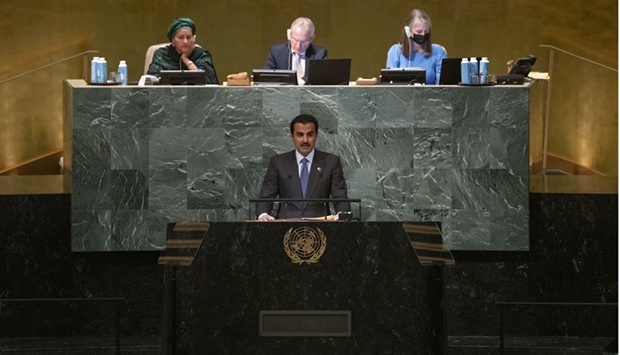
His Highness the Amir took part in the General Debate of the 77th Session of the United Nations General Assembly, which was held in New York City yesterday in the presence of leaders of states and governments and heads of delegations and government and non-government organisations.

Delivering a speech on the occasion, His Highness the Amir said the world has turned into a global village where our concerns are overlapping and our causes are intertwining. "Though the world has changed at a rapid pace in terms of the spread of the effects of any environmental incident, economic crisis or military confrontation at the global level, yet our approaches and methods have not evolved at a similar pace to cope with these transformative changes," the Amir said.

"Whether the belief is that the world is unipolar or multipolar, the international politics is still run in accordance with the rationale of countries that own varying capabilities, interests and priorities, and not in line with the logic of one world and one humanity. I specifically mean the managing of global crises from a perspective of narrow short-term interests, as well as marginalising the international law, and tackling differences according to the balances of power, and not on the basis of the United Nations Charter and respect for the sovereignty of states, " the Amir said adding, "I also mean the absence of sufficient mechanisms to deter and sanction those who commit aggression against the sovereignty of states, and the inability of the international community to impose settlements when they are rejected by the stronger side in any conflict."

The Amir said these circumstances highlight the significance of wisdom and rationality in the attitudes of leaders, and adherence to the principles of justice and fairness in inter-state relations.
Referring to the complexities of the Russian-Ukrainian conflict and its international dimension, the Amir called for a ceasefire and the immediate pursuit of a peaceful solution to the conflict. "This is how the matter would eventually end anyway, no matter how long the war lasts. Its continuation would not change this result, but would rather increase the number of victims, and double its severe consequences for Europe, Russia and the global economy in general."
Reminding the delegates of the attending countries about the need to address the
unresolved Palestinian cause, the Amir said that in light of the failure to implement the resolutions of international legitimacy and with the persistent change of facts on the ground, the settler occupation has pursued a fait accompli policy, and this may change the rules of the conflict as well as the global solidarity configuration in the future. "Hence, I reiterate our full solidarity with the brotherly Palestinian people in their aspiration for justice, and I also reiterate the need for the Security Council to assume its responsibility by compelling Israel to end the Palestinian territories occupation and establish a Palestinian state on the 1967 borders with East Jerusalem as its capital."

On Syria, His Highness the Amir said that the international community failed to hold the war criminals in that country accountable for what they had perpetrated. "And in furtherance of the disillusionment, some are seeking to turn the page on the tragedy of the Syrian people without a quid pro quo while ignoring the great sacrifices made by this afflicted people without a solution to achieve their aspirations, the unity of Syria and its peace and stability." The Amir said the United Nations should not accept that the political path can be summed up in the so-called constitutional committee and under its auspices.

"The Syrian case presents an important lesson regarding the consequences of the absence of a long-term vision from the active forces of the international community when it comes to addressing people's suffering from absolute tyranny, extreme poverty and civil wars before the ensuing repercussions, such as asylum, become the problem that needs to be resolved.
"We highly appreciate the role of the countries that have received Syrian refugees, yet we could not but mention that we must pay attention to the roots of the issues before their impacts knock on the doors of our countries."
The Amir demanded an immediate international action to complete the political process in Libya, agree on the constitutional basis for elections and unify state institutions. "Everyone realises that the state cannot be restored without uniting the military forces and rehabilitating the armed factions into a single national army, discarding those who reject this solution and holding them accountable."

The Amir said in Yemen, "we see a glimmer of hope in the parties' consensus on a temporary truce, and we are looking forward to a comprehensive and permanent ceasefire in preparation for negotiations between the Yemeni parties on the basis of the outcomes of the National Dialogue, the Gulf Initiative and the relevant Security Council resolutions, especially Resolution 2216."
The Amir hoped that a national consensus will be achieved in each of Iraq, Lebanon and Sudan, through the political elites ascent to the level of the required and known tasks necessary to make it possible to achieve the aspirations of the citizens, which guarantee the unity of the people and the nation and preserve its diversity at the same time. "It is not only possible, but also very realistic if there is a will and willingness to make concessions to reach compromises and abandon the sectarian partisan quotas approach which is rejected by the younger generations."
His Highness the Amir highlighted the necessity of reaching a just agreement on the Iranian nuclear programme that addresses the fears of all parties, guarantees that the region is a nuclear-weapon-free zone, and the right of the Iranian people to utilise nuclear energy for peaceful purposes. "No one has an alternative to such an agreement, and reaching it would be in the interest of the security and stability of the region and will open the door to a broader dialogue at the regional security level."
As for Afghanistan, the Amir called on all parties to preserve and build on the Doha Peace Agreement achievements, namely, preventing Afghanistan from becoming a haven for terrorist and radical individuals and groups, so that the Afghan people may attain the long-awaited stability and prosperity.
"We have repeatedly stressed the need to protect civilians, respect human and citizen rights in Afghanistan, including women's rights, girls' right to education, and achieve national reconciliation among the factions of the Afghan people. We have also warned against the danger of isolating Afghanistan and the counterproductive consequences of besieging it."
The Amir attributed the unprecedented energy crisis of today to the lack of global coordination and rational and balanced energy policy planning over many decades. "Nearly a billion people worldwide are living without a reliable primary source of energy. The war crisis in Ukraine might be a new one, but the situations wherein political crises evolve into an energy crisis are not new, as they were exacerbating quietly even before the war in Ukraine."
The Amir said decades of pressure to halt investments in fossil energy before preparing sustainable and eco-friendly alternatives has triggered energy supply shortages. "There is no doubt that climate change and environment protection in general require us to diversify energy sources as soon as possible, but we have to provide energy in the meantime, and to realistically realise that the future of energy would include a diverse mix of its sustainable sources, such as solar energy, hydrogen, wind energy and hydrocarbon sources."
His Highness Sheikh Tamim said by virtue of Qatar's investment in liquefied natural gas decades ago, the country has now been able to embark on the expansion of the North Gas Field, which will play a pivotal role in mitigating the energy shortage crisis in significant parts of the world.
"Some commodities such as energy, food and medicine place responsibility on their exporters and that responsibility goes beyond the commercial liability, which starts with reliability and respect for covenants. Furthermore, it is untenable to block the flow of such goods or ban their export or import during the stages of the political crises, nor acceptable to blockade countries, and to the same extent they may not be used as a tool in conflicts, because they are not a weapon. Just as it is not acceptable to control water resources as if they are political tools."
His Highness the Amir said the realities of our world today depict a bleak image of the future of humanity, but we believe in dialogue, joint action, and an attempt by each party to understand the other by putting himself in someone else's position in order to see things from the perspective of that other party.
"Small and medium-size countries are in most need of stable rules regulating international relations, since dependency on the great powers should not be a reason for failure to maintain communication between us. Each of us has a role to play, and what seems impossible today may become an achievable reality when there is a vision, will and good intentions."
His Highness the Amir said the approach taken in Qatar is to focus on national and human development internally, in addition to adopting a foreign policy based on balancing interests and principles, and mediation in the peaceful settlement of disputes, besides recognition of our responsibility as an energy exporter. "This has empowered us to solidify our reputation as an internationally reliable partner."
The Amir said Qatar will welcome the world in November of this year when it hosts the FIFA World Cup 2022. "The challenge we took up twelve years ago required real resolve, determination, a lot of planning and hard work. And here we are today, standing on the threshold of hosting the world's teams and their fans, and opening our doors in Doha for all of them without discrimination to enjoy the football matches and the amazing atmosphere of the tournament, in addition to witnessing the economic and cultural renaissance in my country.
"In this tournament, which will be held for the first time in an Arab Muslim country, and for the first time in the Middle East in general, the world will see that one of the small and medium-size countries is able to host global events with exceptional and impressive success, in addition to its ability to provide a spacious ambience for diversity and constructive interaction between peoples.
"We note the signs of the positive impact of this event in our region, as brotherly Arab countries regarded the Hayya card, which includes an entry visa to Qatar, as also a visa for Hayya Card holders to enter these countries, a situation that received a warm welcome from the public opinion, and inspired Arab people to look forward to a barrier-free future between people.
"The Qatari people will receive with open arms football fans from all walks of life. The Almighty says: "And We made you into peoples and tribes that you may know one another." No matter how diverse our nationalities, religions and ideas are, but our duty is to overcome obstacles, extend a hand of friendship, build bridges of understanding and celebrate our common humanity, and on behalf of my people and on my own behalf, I invite you all to come to Qatar and enjoy this unique tournament, you are all welcome," the Amir said concluding his speech.
At the outset, the Amir said it pleased him to congratulate Csaba Korosi on assuming the presidency of the 77th session of the General Assembly, wishing him success. He also expressed appreciation for Abdulla Shahid, President of the 76th session, for his efforts, and valued the efforts of Antonio Guterres, Secretary-General of the United Nations, to strengthen the role of the United Nations to achieve its objectives.