


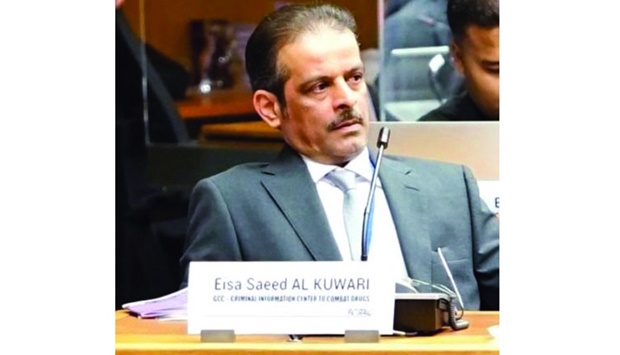
He revealed the high rates of using shipping methods such as express mail and regular mail in the illegal trade in narcotic substances, with a significant increase in the number of websites that promote narcotic substances, considering the promotion of drugs via the internet and smuggling through postal parcels an ongoing challenge, represented by the exploitation of postal and courier services, and other transport services to distribute narcotic substances that are not known to have legitimate use, including psychotropic substances, and chemicals.
After his participation in the 5th annual international operational expert meeting to address trafficking in dangerous synthetic drugs and related chemicals through postal, express mail, courier and air cargo services, organised by the International Narcotics Control Board (INCB) at the UN headquarters in Vienna, Brig. Gen. al-Kuwari said that the participation in the conference came after the operational successes achieved since the co-operation agreement between the INCB and the UPU, where the conference was organised in the framework of the Global Rapid Interdiction of Dangerous Substances (GRIDS) Programme's Opioids Project,and in the fact that the center has been one of the founders of the project since 2018 in addition to its work in the field of drug control.
He considered the conference an opportunity to strengthen co-operation between the UPU and the INCB on the one hand, and the center on the other, especially that the smuggling of narcotic substances through postal parcels is steadily increasing, stressing the need to develop regional and international co-operation to combat illicit trafficking in narcotic substances of all kinds.
The conference came up with many recommendations, the most prominent of which is the co-operation of anti-drug agencies and regional and international organisations and the exchange of intelligence information in the field of drug control in general and postal parcels in particular, including the exchange of experiences and training, in addition to working on the development of co-operation mechanisms between anti-drug agencies and postal service companies.
The adoption of UN international platforms that track the export and import of chemical substances was also emphasised, in addition to the need for communication between national drug control agencies, regional and international organisations among themselves, and with the INCB's local and regional legislation to know about subsequent changes, threats, notifications and assessments related to narcotic substances in order to increase safe circulation between networks of global focal points.
The conference was attended by officers and officials from 30 countries and international organisations, including the UPU, the Caribbean Community Implementation Agency for Crime and Security, the GCC-CICCD, Interpol, the Customs Organisation of Oceania, the Postal Union of the Americas, the UN Office on Drugs and Crime and the World Customs Organisation.
After his participation in the 5th annual international operational expert meeting to address trafficking in dangerous synthetic drugs and related chemicals through postal, express mail, courier and air cargo services, organised by the International Narcotics Control Board (INCB) at the UN headquarters in Vienna, Brig. Gen. al-Kuwari said that the participation in the conference came after the operational successes achieved since the co-operation agreement between the INCB and the UPU, where the conference was organised in the framework of the Global Rapid Interdiction of Dangerous Substances (GRIDS) Programme's Opioids Project,and in the fact that the center has been one of the founders of the project since 2018 in addition to its work in the field of drug control.
He considered the conference an opportunity to strengthen co-operation between the UPU and the INCB on the one hand, and the center on the other, especially that the smuggling of narcotic substances through postal parcels is steadily increasing, stressing the need to develop regional and international co-operation to combat illicit trafficking in narcotic substances of all kinds.
The conference came up with many recommendations, the most prominent of which is the co-operation of anti-drug agencies and regional and international organisations and the exchange of intelligence information in the field of drug control in general and postal parcels in particular, including the exchange of experiences and training, in addition to working on the development of co-operation mechanisms between anti-drug agencies and postal service companies.
The adoption of UN international platforms that track the export and import of chemical substances was also emphasised, in addition to the need for communication between national drug control agencies, regional and international organisations among themselves, and with the INCB's local and regional legislation to know about subsequent changes, threats, notifications and assessments related to narcotic substances in order to increase safe circulation between networks of global focal points.
The conference was attended by officers and officials from 30 countries and international organisations, including the UPU, the Caribbean Community Implementation Agency for Crime and Security, the GCC-CICCD, Interpol, the Customs Organisation of Oceania, the Postal Union of the Americas, the UN Office on Drugs and Crime and the World Customs Organisation.