


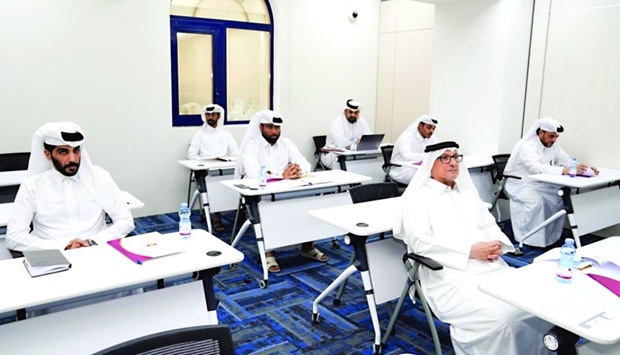
The Ministry of Justice has launched specialised training courses in the fields of arbitration as part of the ministry's efforts to qualify Qatari arbitrators.
The first-of-its-kind training program includes preparatory courses for junior arbitrators and advanced courses for specialised arbitrators in commercial and civil arbitration, aiming to improve the arbitration environment and enable various categories of arbitrators to have arbitration skills and experience.
On this occasion, Assistant Undersecretary at the Office of the Minister in charge of the tasks of the Assistant Undersecretary for Legal Affairs Ahmed Hassan al-Kuwari stressed the ministry's keenness to upgrade, modernise and develop the legal professions in the country, and provide them with Qatari cadres in various specialties.
Al-Kuwari added that the ministry has started preparing a national list of accredited arbitrators in light of the Civil and Commercial Arbitration Law issued by Law No. 2 of 2017, and has also addressed a number of international arbitration centres to inform them of the content of the law, which was previously prepared by the ministry in the framework of implementing the directives of the wise leadership to provide effective means to settle disputes and create a stimulating environment for business and investment. This is in keeping pace with the current and future economic growth and investment expansion; in order to contribute to making Qatar a regional hub for international arbitration, which contributes to facilitating judicial proceedings and informing about the responsibility of arbitrators, when initiating arbitration proceedings, provide an alternative mechanism characterized by speed and specialisation to resolve disputes in various fields, especially commercial.
Al-Kuwari pointed out that the ministry seeks, through its training program, to spread the culture of arbitration in the country and activate it to benefit various government and private entities, especially in light of the economic openness witnessed by Qatar, which is strengthened by the issuance of current laws, including the law regulating non-Qatari capital investment in economic activity, the law regulating the ownership and use of real estate by non-Qataris, and other laws that put Qatar at the forefront of the most attractive countries for foreign investment.
This requires fast and effective legislative tools consistent with international best practices and modern trends in the field of arbitration, where most articles of the law are compatible with the model law on international commercial arbitration, adopted by the United Nations Commission On International Trade Law (UNCITRAL), and the amendments to it, which were adopted in 2006. The law also provides Qatari and non-Qatari arbitrators with the main provisions of arbitration, and enables them to benefit from previous experiences in the field of international arbitration based on the model arbitration law.
For her part, supervisor of specialised arbitration courses at the ministry Noura Hammoud al-Mannai said that these courses are offered in co-operation with the Center of Legal and Judicial Studies, and will be divided into courses for junior arbitrators, including a course on alternative means of dispute resolution (arbitration-mediation), a course on the arbitration agreement (its controls-drafting rules-legal effects), in addition to courses related to specialised arbitrators, including commercial and civil arbitration.
New programs, that have also been developed, will be introduced during the coming period, including arbitration procedures, arbitration ruling and its implementation, and sports arbitration. She explained that a number of bodies related to the field of arbitration have been contacted to nominate their employees to equip them with the culture of arbitration, and expressed the hope that these courses will contribute to filling the gap that existed in the absence of specialised courses in this field, which the ministry seeks to address, and to put forward an integrated training program in the future.
The first-of-its-kind training program includes preparatory courses for junior arbitrators and advanced courses for specialised arbitrators in commercial and civil arbitration, aiming to improve the arbitration environment and enable various categories of arbitrators to have arbitration skills and experience.
On this occasion, Assistant Undersecretary at the Office of the Minister in charge of the tasks of the Assistant Undersecretary for Legal Affairs Ahmed Hassan al-Kuwari stressed the ministry's keenness to upgrade, modernise and develop the legal professions in the country, and provide them with Qatari cadres in various specialties.
Al-Kuwari added that the ministry has started preparing a national list of accredited arbitrators in light of the Civil and Commercial Arbitration Law issued by Law No. 2 of 2017, and has also addressed a number of international arbitration centres to inform them of the content of the law, which was previously prepared by the ministry in the framework of implementing the directives of the wise leadership to provide effective means to settle disputes and create a stimulating environment for business and investment. This is in keeping pace with the current and future economic growth and investment expansion; in order to contribute to making Qatar a regional hub for international arbitration, which contributes to facilitating judicial proceedings and informing about the responsibility of arbitrators, when initiating arbitration proceedings, provide an alternative mechanism characterized by speed and specialisation to resolve disputes in various fields, especially commercial.
Al-Kuwari pointed out that the ministry seeks, through its training program, to spread the culture of arbitration in the country and activate it to benefit various government and private entities, especially in light of the economic openness witnessed by Qatar, which is strengthened by the issuance of current laws, including the law regulating non-Qatari capital investment in economic activity, the law regulating the ownership and use of real estate by non-Qataris, and other laws that put Qatar at the forefront of the most attractive countries for foreign investment.
This requires fast and effective legislative tools consistent with international best practices and modern trends in the field of arbitration, where most articles of the law are compatible with the model law on international commercial arbitration, adopted by the United Nations Commission On International Trade Law (UNCITRAL), and the amendments to it, which were adopted in 2006. The law also provides Qatari and non-Qatari arbitrators with the main provisions of arbitration, and enables them to benefit from previous experiences in the field of international arbitration based on the model arbitration law.
For her part, supervisor of specialised arbitration courses at the ministry Noura Hammoud al-Mannai said that these courses are offered in co-operation with the Center of Legal and Judicial Studies, and will be divided into courses for junior arbitrators, including a course on alternative means of dispute resolution (arbitration-mediation), a course on the arbitration agreement (its controls-drafting rules-legal effects), in addition to courses related to specialised arbitrators, including commercial and civil arbitration.
New programs, that have also been developed, will be introduced during the coming period, including arbitration procedures, arbitration ruling and its implementation, and sports arbitration. She explained that a number of bodies related to the field of arbitration have been contacted to nominate their employees to equip them with the culture of arbitration, and expressed the hope that these courses will contribute to filling the gap that existed in the absence of specialised courses in this field, which the ministry seeks to address, and to put forward an integrated training program in the future.