


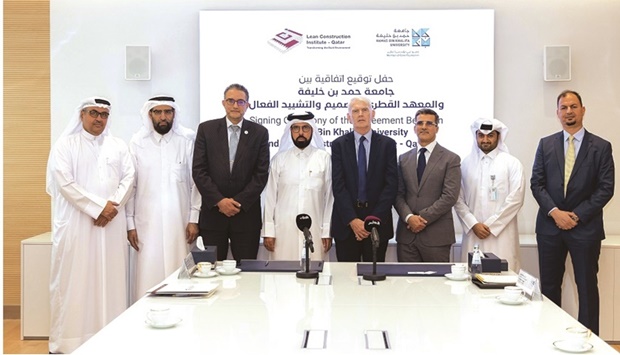
Hamad Bin Khalifa University (HBKU) and the Lean Construction Institute-Qatar (LCI-Q) have signed a three-year memorandum of understanding (MoU) to collaborate on research and education that enhances the adoption of ‘Lean Construction’ in Qatar.
LCI-Qatar’s goal to enhance the construction industry - through the efficiency and productivity gains inherent in applying ‘Lean’ principles and practices - broadly align with HBKU’s research priorities focusing on sustainability challenges and opportunities related to infrastructure.
This joint MoU will be a catalyst to connect theory and practice to bridge the gap between academia and industry and enhance the knowledge and adoption of international best practices in Lean Design and Construction in Qatar. HBKU’s research and development activities combined with LCI-Qatar’s expertise represents a unique and advantageous opportunity to address the needs and challenges facing stakeholders.
In addition to joint research and development activities, the agreement focuses on capacity building. Reciprocal training initiatives will include internships and other programmes for HBKU students to enhance their skills and engagement with the industry. These training opportunities will also extend to the wider engineering, facility design and operation, and infrastructure sector.
The new MoU was executed recently at a signing ceremony at HBKU headquarters, in the presence of the LCI-Qatar president, Dr Abdulla Yaqoub al-Sayed, and board members of the institute. Also in attendance were HBKU representatives Dr Richard O’Kennedy, vice president for research and Dr Rachid Zaffou, senior planning and research director.
After the signing, Dr Richard O’Kennedy said: “Our agreement will enable research initiatives that contribute to catalysing the growth of sustainable buildings and infrastructure for Qatar by coupling sustainability and efficiency.”
Dr al-Sayed at LCI-Qatar said: “Since 2019, LCI-Qatar’s efforts have been to enhance the performance of construction projects to generate value, eliminate waste, increase efficiency, and maximise productivity through the Lean project delivery approach. We welcome this opportunity to co-operate with HBKU and benefit from the university’s scientific research and educational expertise.”
This joint MoU will be a catalyst to connect theory and practice to bridge the gap between academia and industry and enhance the knowledge and adoption of international best practices in Lean Design and Construction in Qatar. HBKU’s research and development activities combined with LCI-Qatar’s expertise represents a unique and advantageous opportunity to address the needs and challenges facing stakeholders.
In addition to joint research and development activities, the agreement focuses on capacity building. Reciprocal training initiatives will include internships and other programmes for HBKU students to enhance their skills and engagement with the industry. These training opportunities will also extend to the wider engineering, facility design and operation, and infrastructure sector.
The new MoU was executed recently at a signing ceremony at HBKU headquarters, in the presence of the LCI-Qatar president, Dr Abdulla Yaqoub al-Sayed, and board members of the institute. Also in attendance were HBKU representatives Dr Richard O’Kennedy, vice president for research and Dr Rachid Zaffou, senior planning and research director.
After the signing, Dr Richard O’Kennedy said: “Our agreement will enable research initiatives that contribute to catalysing the growth of sustainable buildings and infrastructure for Qatar by coupling sustainability and efficiency.”
Dr al-Sayed at LCI-Qatar said: “Since 2019, LCI-Qatar’s efforts have been to enhance the performance of construction projects to generate value, eliminate waste, increase efficiency, and maximise productivity through the Lean project delivery approach. We welcome this opportunity to co-operate with HBKU and benefit from the university’s scientific research and educational expertise.”