


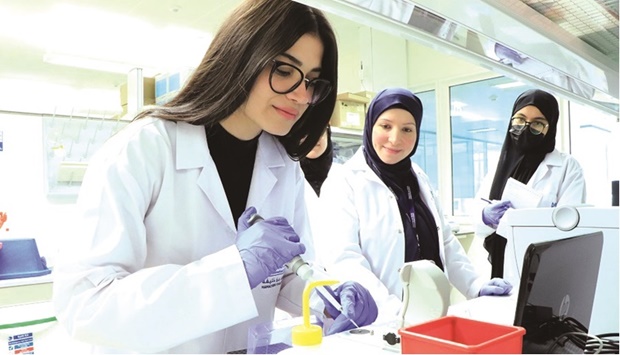
Qatar Biomedical Research Institute (QBRI) at Hamad Bin Khalifa University concluded its Summer Research Programme (SRP) 2022 with an appreciation ceremony on August 18 to showcase student experiences through poster presentations.
The event wrapped up two months of intensive training in specific fields of biomedical research for some of the country’s promising undergraduate students. In its sixth edition, the competitive SRP attracted 21 students from Qatar University (QU), Carnegie Mellon University in Qatar (CMU-Q), Weill Cornell Medicine in Qatar, and the University of Calgary in Qatar.
The students had the chance to spend eight weeks at QBRI and experience exciting basic and translational scientific research areas.
In addition to hands-on experience in QBRI’s state-of-the-art laboratories, the students participated in professional development activities and workshops focusing on innovation in research, experimental design, research reproducibility, and open science, among others.
Much of the focus was on their individual projects. These are related to current research on stem cells, diabetes, breast cancer, and neurological disorders, linked to work done by top biomedical researchers at QBRI. During the appreciation ceremony, each student presented their project in a poster format in the presence of their mentors.
Sanaa al-Marri, a student in the Biological Sciences Programme at CMU-Q, commented: “I gained tremendous exposure to what a researcher does post-graduation. I am grateful for this experience and the many techniques and skills I learned at QBRI during the Summer Research Programme.”
Rizeq Hourani, enrolled in the College of Medicine at QU, added: “The experience was exceptional. QBRI researchers were knowledgeable and willing to teach us the fundamentals of laboratory and research work. As a professional environment, it was comfortable and full of life. I could not have asked for a better programme.”
Dr Omar El-Agnaf, QBRI executive director, also noted: “Such opportunities allow QBRI scientists to mentor the future generation of researchers by showing them the work that we do, which will pave the way for them to contribute to enhancing healthcare in Qatar.”
The students had the chance to spend eight weeks at QBRI and experience exciting basic and translational scientific research areas.
In addition to hands-on experience in QBRI’s state-of-the-art laboratories, the students participated in professional development activities and workshops focusing on innovation in research, experimental design, research reproducibility, and open science, among others.
Much of the focus was on their individual projects. These are related to current research on stem cells, diabetes, breast cancer, and neurological disorders, linked to work done by top biomedical researchers at QBRI. During the appreciation ceremony, each student presented their project in a poster format in the presence of their mentors.
Sanaa al-Marri, a student in the Biological Sciences Programme at CMU-Q, commented: “I gained tremendous exposure to what a researcher does post-graduation. I am grateful for this experience and the many techniques and skills I learned at QBRI during the Summer Research Programme.”
Rizeq Hourani, enrolled in the College of Medicine at QU, added: “The experience was exceptional. QBRI researchers were knowledgeable and willing to teach us the fundamentals of laboratory and research work. As a professional environment, it was comfortable and full of life. I could not have asked for a better programme.”
Dr Omar El-Agnaf, QBRI executive director, also noted: “Such opportunities allow QBRI scientists to mentor the future generation of researchers by showing them the work that we do, which will pave the way for them to contribute to enhancing healthcare in Qatar.”