


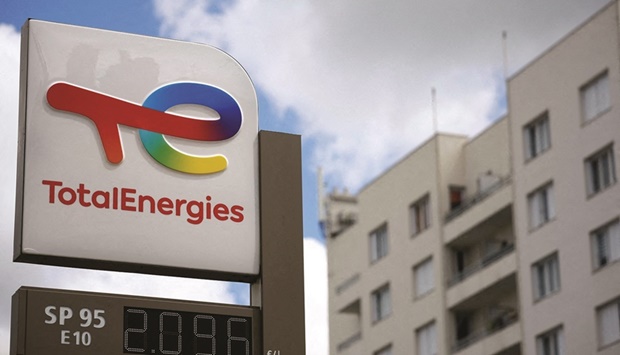
French energy giant TotalEnergies said yesterday its profits more than doubled in the second quarter on the surge in global oil and gas prices as a result of the war in Ukraine.
TotalEnergies said in a statement that its bottom-line net profit amounted to €5.7bn ($5.8bn) in the period from April to June, compared with €2.2bn a year earlier.
Second-quarter sales were up 37% at €74.8bn.
"Russia's invasion of Ukraine continued to impact energy markets in the second quarter, with oil prices averaging more than $110 per barrel, refining margins reaching record-high levels, and natural gas prices holding above oil partly in Europe and Asia," said chief executive Patrick Pouyanne.
"In this context, TotalEnergies responded by increasing energy output, thus contributing to energy security."
Runaway oil and gas prices are generating bumper profits across the sector.
British energy giant Shell also said on Thursday its bottom line increased five-fold in the second quarter.
In France, there is much debate on whether such windfall gains should be taxed.
Pfizer
Pfizer reported a jump in second-quarter profits yesterday behind a near doubling of revenues driven by sales of its Covid-19 vaccine and therapeutic drug Paxlovid.
The drugmaker raised some of its overall financial benchmarks, but maintained 2022 sales targets for its two Covid-19 products: $32bn from the vaccine co-developed with German company BioNTech; and $22bn from Paxlovid.
The total is equal to just over half of forecasted 2022 total revenues.
In the quarter ending June 30, profits were $9.9bn, up 78% from the year-ago period following a 47% jump in revenues to $27.7bn.
US officials last month approved emergency authorisation to Pfizer and Moderna for Covid-19 vaccines in under-five-year-olds, the final age group awaiting immunisation in most countries.
Pfizer is currently working on a Covid-19 Omicron vaccine booster candidate for the fall, assuming regulatory approval is granted, company officials said.
Revenues for the vaccine came in at $8.8bn, up 13% from the year-ago period, while sales of Paxlovid were $8.1bn — a big jump over the prior quarter following a five-fold growth in US utilisation.
Volkswagen
German auto giant Volkswagen said yesterday that it was able to overcome global economic headwinds and supply chain issues to put in a "robust" performance in the first six months of 2022.
A week after Volkswagen announced that it would part ways with its chief executive Herbert Diess, the carmaker said it was "confident" for the second half of the year.
"Despite unprecedented global challenges, Volkswagen has demonstrated remarkable financial robustness," said chief financial officer Arno Antlitz.
"Despite all the caution in the face of the volatile market environment and geopolitical risks, we are confident that we can further accelerate the transformation of the group," Antlitz said.
VW said its net profit rose by 26% to €10.6bn ($10.8bn) in the first six months, even if its bottom-line in the second quarter alone was hit by an accounting effect linked to hedging against fluctuations in raw material prices.
Underlying, or operating, profit rose by 16% to €13.2bn in the period from January to June.
"This was driven by strong performances from the premium and sport brand group," VW said.
First-half revenues were nearly stable at €132.3bn, but unit sales were down by 14% at four million vehicles, not least because of the worldwide shortage of semiconductors plaguing the industry.
Looking ahead, Volkswagen said it "confirms its outlook for 2022...as supply constraints ease."
The carmaker expected "the product mix to normalise in the second-half as the semi-conductor situation improves in combination with a strong order book," it said.
"A noticeable recovery of the monthly sales towards the end of second quarter additionally bodes well for second-half sales," it said.
Nevertheless, it was "still not possible to conclusively assess the specific effects of the war in Ukraine or effects of the Covid-19 pandemic on the Volkswagen group's business, on the global economy and growth in the industry in fiscal year 2022," VW cautioned.
Samsung Electronics
South Korean chip powerhouse Samsung Electronics said that second-quarter operating profits were up 12.18%, with record profits in its system semiconductor division despite global supply chain woes.
The company's "system semiconductor businesses... achieved a record high quarterly profit," Samsung said in a statement, adding it had both expanded its product line-up and increased the supply of chips to global customers.
"Earnings in the Memory Business improved both year-on-year and quarter-on-quarter as the Company focused on meeting solid demand for servers," Samsung said.
In June, the company became the first chipmaker in the world to mass-produce 3-nanometre microchips as it sought to match and eventually outpace Taiwan's TSMC in the race to manufacture the world's most advanced chips.
The new chips will be smaller, more powerful and efficient, and will be used in high-performance computing applications before being put into gadgets such as mobile phones.
The vast majority of the world's most advanced microchips are made by just two companies -- Samsung and TSMC -- both of which are running at full capacity to alleviate a global shortage.
Merck & Co
Merck & Co reported higher-than-expected second-quarter earnings and revenue on strong sales of its blockbuster cancer drug Keytruda.
The company said it earned $4.74bn in the quarter, or $1.87 a share, compared with $1.55bn, or 61 cents a share, a year earlier.
Analysts on average had expected the company to earn $1.70 a share, according to Refinitiv data.
Revenue in the quarter rose 28% from a year ago to $14.6bn, topping the average Wall Street forecast of $13.9bn.
Much of that beat came from sales of Merck's top-selling drug, the cancer immunotherapy Keytruda, which came in at $5.3bn for the quarter, compared with analyst estimates of $4.9bn.
On Wednesday, US Senator Ron Wyden, a Democrat, sent a letter to Merck suggesting the company had avoided billions of dollars of US taxes owed from Keytruda sales in recent years by booking all the profits from the treatment outside of the United States.
Sales of Merck's Covid-19 antiviral treatment Lagevrio were $1.2bn in the quarter, primarily from the UK and Japan.
Merck raised its full-year sales forecast to $57.5bn to $58.5bn from its previous outlook of $56.9bn to $58.1bn.
That includes a negative impact of roughly 3% due to the strong dollar.
Analysts had forecast 2022 sales of $58.1bn, according to Refinitiv data.
ArcelorMittal
ArcelorMittal, the world's number-two steel maker, said that profits fell in the second quarter, weighed down by inflation and the war in Ukraine.
The group said in a statement its performance was "overshadowed by the outbreak of war in Ukraine, where we have steel and mining operations".
"Globally, the conflict is impacting growth and adding further inflationary pressure, which is spilling over into weakening of demand (for steel)," the group said.
In the second quarter, net profit eased by 2% to $3.9bn.
But over the first half, ArcelorMittal's bottom line increased by 27% to $8.0bn, primarily due to a strong performance in the first three months of the year.
ArcelorMittal said steel output fell by 18% to 14.6mn tonnes in the period from April to June.
Second-quarter sales, on the other hand, grew by 14.5% to just over €22bn, driven by an increase of some 30% in steel prices.
ArcelorMittal employs some 26,000 people in Ukraine and suspended its operation there when the war broke out.
But it said in May it would resume operations in Ukraine, even if only one of the three furnaces there has since restarted.
Looking ahead, chief executive Adity Mittal said that "despite the more uncertain global macro outlook", the business was "well positioned to effectively manage through the cycle".
Barclays
British bank Barclays said yesterday that profits tumbled on bad debt charges and litigation costs in the first half, and warned on the impact of surging inflation on customers.
Net profit sank to £2.5bn ($3.0bn) in the six months to June, from £3.8bn a year earlier, Barclays said in a statement.
Total provisions and legal charges hit £1.8bn, 10 times higher than last time around.
Barclays booked a net charge of £600mn after selling more products to investors in the United States than it was allowed.
It also set aside £341mn for potential loan losses and warned over the impact of Britain's cost-of-living crisis — echoing remarks from rival UK lender Lloyds.
"We are alert to the pressure that the rising cost of living will have on our customers and colleagues," said Barclays chief executive CS Venkatakrishnan.
"We have a range of measures in place to help and are looking to do more."
Barclays forecast UK economic growth would slow, but said it was difficult to say if it would enter recession.
Earlier this week, the International Monetary Fund cut its UK economic outlook due to stalling global growth.
Shell
British energy giant Shell said yesterday that its net profit soared more than five-fold to $18bn in the second quarter, fuelled by resurgent oil and gas prices, and rewarded shareholders with another bumper buyback.
The surge in profits in the three months to June was partially attributable to a reversal of $4.3bn in impairments after the company raised its forecasts for the gas and oil market.
"We delivered strong financial results," said chief executive Ben van Beurden alongside the results statement.
The London-listed energy major announced a $6bn share buyback programme, having already returned $8.5bn to shareholders.
Van Beurden warned also that "with volatile energy markets, economic turbulence and the ongoing need for action to tackle climate change, 2022 continues to present challenges to consumers, to government, and to companies". Shell had rebounded into a $3.4bn profit in second quarter of 2021 from a $18.1bn loss in the same period of 2020 when it took a massive impairment charge on the Covid-ravaged oil market.
However, oil and gas prices have soared this year owing to the Ukraine war and after countries lifted pandemic lockdowns.
Gas prices, which sky-rocketed in March after Russia launched its invasion of Ukraine, are soaring once more this week after Moscow curbed crucial deliveries to Europe in recent days.
The world's energy majors are reaping the benefits of this year's surge in global oil and gas prices as a result of the war in Ukraine.
TotalEnergies said in a statement that its bottom-line net profit amounted to €5.7bn ($5.8bn) in the period from April to June, compared with €2.2bn a year earlier.
Second-quarter sales were up 37% at €74.8bn.
"Russia's invasion of Ukraine continued to impact energy markets in the second quarter, with oil prices averaging more than $110 per barrel, refining margins reaching record-high levels, and natural gas prices holding above oil partly in Europe and Asia," said chief executive Patrick Pouyanne.
"In this context, TotalEnergies responded by increasing energy output, thus contributing to energy security."
Runaway oil and gas prices are generating bumper profits across the sector.
British energy giant Shell also said on Thursday its bottom line increased five-fold in the second quarter.
In France, there is much debate on whether such windfall gains should be taxed.
Pfizer
Pfizer reported a jump in second-quarter profits yesterday behind a near doubling of revenues driven by sales of its Covid-19 vaccine and therapeutic drug Paxlovid.
The drugmaker raised some of its overall financial benchmarks, but maintained 2022 sales targets for its two Covid-19 products: $32bn from the vaccine co-developed with German company BioNTech; and $22bn from Paxlovid.
The total is equal to just over half of forecasted 2022 total revenues.
In the quarter ending June 30, profits were $9.9bn, up 78% from the year-ago period following a 47% jump in revenues to $27.7bn.
US officials last month approved emergency authorisation to Pfizer and Moderna for Covid-19 vaccines in under-five-year-olds, the final age group awaiting immunisation in most countries.
Pfizer is currently working on a Covid-19 Omicron vaccine booster candidate for the fall, assuming regulatory approval is granted, company officials said.
Revenues for the vaccine came in at $8.8bn, up 13% from the year-ago period, while sales of Paxlovid were $8.1bn — a big jump over the prior quarter following a five-fold growth in US utilisation.
Volkswagen
German auto giant Volkswagen said yesterday that it was able to overcome global economic headwinds and supply chain issues to put in a "robust" performance in the first six months of 2022.
A week after Volkswagen announced that it would part ways with its chief executive Herbert Diess, the carmaker said it was "confident" for the second half of the year.
"Despite unprecedented global challenges, Volkswagen has demonstrated remarkable financial robustness," said chief financial officer Arno Antlitz.
"Despite all the caution in the face of the volatile market environment and geopolitical risks, we are confident that we can further accelerate the transformation of the group," Antlitz said.
VW said its net profit rose by 26% to €10.6bn ($10.8bn) in the first six months, even if its bottom-line in the second quarter alone was hit by an accounting effect linked to hedging against fluctuations in raw material prices.
Underlying, or operating, profit rose by 16% to €13.2bn in the period from January to June.
"This was driven by strong performances from the premium and sport brand group," VW said.
First-half revenues were nearly stable at €132.3bn, but unit sales were down by 14% at four million vehicles, not least because of the worldwide shortage of semiconductors plaguing the industry.
Looking ahead, Volkswagen said it "confirms its outlook for 2022...as supply constraints ease."
The carmaker expected "the product mix to normalise in the second-half as the semi-conductor situation improves in combination with a strong order book," it said.
"A noticeable recovery of the monthly sales towards the end of second quarter additionally bodes well for second-half sales," it said.
Nevertheless, it was "still not possible to conclusively assess the specific effects of the war in Ukraine or effects of the Covid-19 pandemic on the Volkswagen group's business, on the global economy and growth in the industry in fiscal year 2022," VW cautioned.
Samsung Electronics
South Korean chip powerhouse Samsung Electronics said that second-quarter operating profits were up 12.18%, with record profits in its system semiconductor division despite global supply chain woes.
The company's "system semiconductor businesses... achieved a record high quarterly profit," Samsung said in a statement, adding it had both expanded its product line-up and increased the supply of chips to global customers.
"Earnings in the Memory Business improved both year-on-year and quarter-on-quarter as the Company focused on meeting solid demand for servers," Samsung said.
In June, the company became the first chipmaker in the world to mass-produce 3-nanometre microchips as it sought to match and eventually outpace Taiwan's TSMC in the race to manufacture the world's most advanced chips.
The new chips will be smaller, more powerful and efficient, and will be used in high-performance computing applications before being put into gadgets such as mobile phones.
The vast majority of the world's most advanced microchips are made by just two companies -- Samsung and TSMC -- both of which are running at full capacity to alleviate a global shortage.
Merck & Co
Merck & Co reported higher-than-expected second-quarter earnings and revenue on strong sales of its blockbuster cancer drug Keytruda.
The company said it earned $4.74bn in the quarter, or $1.87 a share, compared with $1.55bn, or 61 cents a share, a year earlier.
Analysts on average had expected the company to earn $1.70 a share, according to Refinitiv data.
Revenue in the quarter rose 28% from a year ago to $14.6bn, topping the average Wall Street forecast of $13.9bn.
Much of that beat came from sales of Merck's top-selling drug, the cancer immunotherapy Keytruda, which came in at $5.3bn for the quarter, compared with analyst estimates of $4.9bn.
On Wednesday, US Senator Ron Wyden, a Democrat, sent a letter to Merck suggesting the company had avoided billions of dollars of US taxes owed from Keytruda sales in recent years by booking all the profits from the treatment outside of the United States.
Sales of Merck's Covid-19 antiviral treatment Lagevrio were $1.2bn in the quarter, primarily from the UK and Japan.
Merck raised its full-year sales forecast to $57.5bn to $58.5bn from its previous outlook of $56.9bn to $58.1bn.
That includes a negative impact of roughly 3% due to the strong dollar.
Analysts had forecast 2022 sales of $58.1bn, according to Refinitiv data.
ArcelorMittal
ArcelorMittal, the world's number-two steel maker, said that profits fell in the second quarter, weighed down by inflation and the war in Ukraine.
The group said in a statement its performance was "overshadowed by the outbreak of war in Ukraine, where we have steel and mining operations".
"Globally, the conflict is impacting growth and adding further inflationary pressure, which is spilling over into weakening of demand (for steel)," the group said.
In the second quarter, net profit eased by 2% to $3.9bn.
But over the first half, ArcelorMittal's bottom line increased by 27% to $8.0bn, primarily due to a strong performance in the first three months of the year.
ArcelorMittal said steel output fell by 18% to 14.6mn tonnes in the period from April to June.
Second-quarter sales, on the other hand, grew by 14.5% to just over €22bn, driven by an increase of some 30% in steel prices.
ArcelorMittal employs some 26,000 people in Ukraine and suspended its operation there when the war broke out.
But it said in May it would resume operations in Ukraine, even if only one of the three furnaces there has since restarted.
Looking ahead, chief executive Adity Mittal said that "despite the more uncertain global macro outlook", the business was "well positioned to effectively manage through the cycle".
Barclays
British bank Barclays said yesterday that profits tumbled on bad debt charges and litigation costs in the first half, and warned on the impact of surging inflation on customers.
Net profit sank to £2.5bn ($3.0bn) in the six months to June, from £3.8bn a year earlier, Barclays said in a statement.
Total provisions and legal charges hit £1.8bn, 10 times higher than last time around.
Barclays booked a net charge of £600mn after selling more products to investors in the United States than it was allowed.
It also set aside £341mn for potential loan losses and warned over the impact of Britain's cost-of-living crisis — echoing remarks from rival UK lender Lloyds.
"We are alert to the pressure that the rising cost of living will have on our customers and colleagues," said Barclays chief executive CS Venkatakrishnan.
"We have a range of measures in place to help and are looking to do more."
Barclays forecast UK economic growth would slow, but said it was difficult to say if it would enter recession.
Earlier this week, the International Monetary Fund cut its UK economic outlook due to stalling global growth.
Shell
British energy giant Shell said yesterday that its net profit soared more than five-fold to $18bn in the second quarter, fuelled by resurgent oil and gas prices, and rewarded shareholders with another bumper buyback.
The surge in profits in the three months to June was partially attributable to a reversal of $4.3bn in impairments after the company raised its forecasts for the gas and oil market.
"We delivered strong financial results," said chief executive Ben van Beurden alongside the results statement.
The London-listed energy major announced a $6bn share buyback programme, having already returned $8.5bn to shareholders.
Van Beurden warned also that "with volatile energy markets, economic turbulence and the ongoing need for action to tackle climate change, 2022 continues to present challenges to consumers, to government, and to companies". Shell had rebounded into a $3.4bn profit in second quarter of 2021 from a $18.1bn loss in the same period of 2020 when it took a massive impairment charge on the Covid-ravaged oil market.
However, oil and gas prices have soared this year owing to the Ukraine war and after countries lifted pandemic lockdowns.
Gas prices, which sky-rocketed in March after Russia launched its invasion of Ukraine, are soaring once more this week after Moscow curbed crucial deliveries to Europe in recent days.
The world's energy majors are reaping the benefits of this year's surge in global oil and gas prices as a result of the war in Ukraine.