


China will unveil a bumper set of economic indicators this week that will likely set the pace for monetary and fiscal stimulus for the rest of the year as Beijing chases down its ambitious growth target.
Key data – from gross domestic product and retail sales to fiscal revenue and bank borrowing – will be closely watched to assess the damage of Covid lockdowns during April and May and the strength of the rebound since then as restrictions were eased. The figures will also give clues on the state of the property market, a major drag on growth this year.
Beijing is betting on a stronger second half of the year for the economy as business activity picks up pace and local governments ramp up spending on infrastructure. Even so, meeting the growth target of around 5.5% will prove challenging, especially as China sticks to its stringent Covid Zero policy, with restrictions tightened wherever outbreaks occur. President Xi Jinping recently signalled he’s willing to sacrifice some short-term growth to protect his people’s health.
Ding Shuang, chief economist for Greater China and North Asia at Standard Chartered Plc, said if the full-year target can’t be reached, the government would want to achieve growth in the second half of the year of around the 5.5% mark. Economists surveyed by Bloomberg predict the economy will likely expand just over 4% for the full year.
“There’s still a pretty long distance toward hitting the annual growth target,” said Ding. “There should be further policy support.”
The country’s fiscal and monetary authorities are scheduled to publish government finance as well as bank loan figures this week that could give clues about possible stimulus. In particular, investors are watching closely if Beijing will allow local governments to accelerate their borrowing by possibly selling 1.5tn yuan ($220bn) of special bonds in the second half of this year.
Here’s a look at the key events on China’s economic calendar this week.
Trade: China’s exports were a big driver of the economy’s recovery out of the 2020 pandemic, but that’s not the case this time around. Global trade is weakening as consumers around the world face rising prices and shift their demand away from goods to spending on travel and other services.
Data for June will likely show a moderation in export growth even though Covid disruptions to logistics and supply chains continued to ease in the month. Exports likely grew about 13% in dollar terms from a year ago, down from May’s 16.9%. Growth in imports likely stayed subdued at 4%, largely unchanged from the previous month, a sign of weak domestic demand.
With the Biden administration close to announcing a rollback of some tariffs on Chinese consumer goods, trade may get a boost, although a limited one. UBS Group AG economists including Wang Tao expect the maximum gain to China’s export growth to be 4 percentage points, assuming full removal of Section 301 tariffs and the market share of imports from China returning to a pre-tariff high.
GDP: The economy’s performance in the second quarter was likely the weakest since an historic contraction in the first three months of 2020 when the pandemic first hit. Economists predict GDP likely grew 1.2% in the second quarter from a year ago, down from 4.8% in the first three months of the year. On a quarterly basis, GDP likely shrank 2%.
June activity indicators will be scrutinised for signs of a rebound from Covid lockdowns. Economists’ forecasts suggest a strong pickup in industrial production as factories ramped up output and disruptions in supply chains and logistics eased. The median estimate in a Bloomberg survey of economists is for industrial production to have grown 4%, following a contraction in April and weak growth in May.
Fixed-asset investment likely held up in the first six months of the year thanks to a fiscal boost from the government to support infrastructure construction, though investment in the property sector probably remained sluggish. Retail sales likely increased in June, breaking a three-month declining streak, as Covid restrictions eased and the government made a push to boost sales of cars and home appliances.
Interest rate: The PBoC will have an opportunity to cut the rate on one-year policy loans to provide more monetary support to the economy, although most economists expect it to keep the rate unchanged. Governor Yi Gang recently signalled that monetary stimulus will likely focus on boosting credit rather than lowering interest rates in the rest of the year amid concern about inflation and as rate hikes by the US Federal Reserve fuels worries over capital outflows.
Subdued domestic inflation doesn’t pose an immediate threat to the PBoC’s policy easing. But Goldman Sachs Group Inc economists say consumer prices may rise above 3% in the second half of the year because of surging pork prices, which could raise the bar for any high-profile monetary easing such as policy rate cuts or a reduction in the reserve requirement ratio for banks.
Many economists also expect the PBoC to roll over the medium-term lending facility loans maturing this week. Any withdrawal of liquidity through the MLF will send a stronger signal that the PBoC is normalising liquidity conditions, after it slashed daily open-market operations last week. A total of 100bn yuan ($15bn) of MLF loans will mature.
Credit rebound: Credit data scheduled to be released this week will likely reveal a continued rebound in financing activities in June, which is usually a bumper month as banks ramp up lending at the end of the quarter. Beijing’s policy push also likely played a role, after the People’s Bank of China urged banks to lend more and increased policy banks’ loan quota by 800bn yuan. The surge in local government special bond issuance, which reached a record 1.4tn yuan for the month, also likely contributed to the gain.
Aggregate financing, a broad measure of credit, is forecast to climb to 4.2tn yuan from 2.8tn yuan in May, and exceeding the 3.7tn yuan in June last year, according to the median estimate of economists polled by Bloomberg. New loans likely rose to 2.4tn yuan from 1.9tn yuan in May. The PBoC is also expected to hold a quarterly briefing to discuss lending data and the outlook for monetary policy.
Fiscal income: The Ministry of Finance plans to release data on fiscal income and spending for the first six months of the year. Revenues have plummeted with a housing market downturn dragging down income from land sales and tax revenues shrinking due to rebates to help businesses. Meanwhile, government spending has climbed as costs on Covid testing and controls jumped.
While local governments are struggling to make ends meet, Beijing has pushed them to accelerate debt sales to fund Xi’s infrastructure push. Most of this year’s 3.65tn yuan in special local bonds have already been issued by the end of last month.
The finance ministry is considering allowing local governments to sell an additional 1.5tn yuan of special bonds in the second half. That’s on top of 1.1tn yuan in new support for infrastructure announced over the past few weeks, including the 800bn yuan of additional policy bank loans.
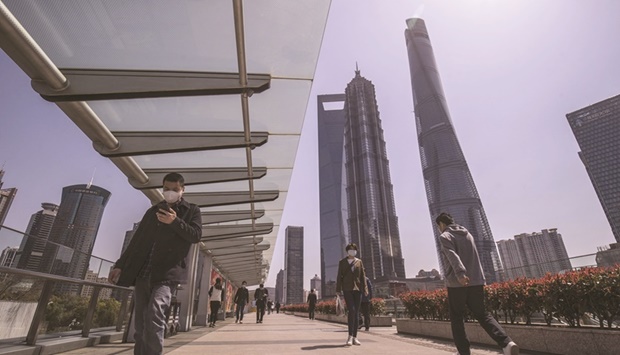
Pedestrians walk through the Lujiazui Financial District in Shanghai. China will unveil a bumper set of economic indicators this week that will likely set the pace for monetary and fiscal stimulus for the rest of the year as Beijing chases down its ambitious growth target.