


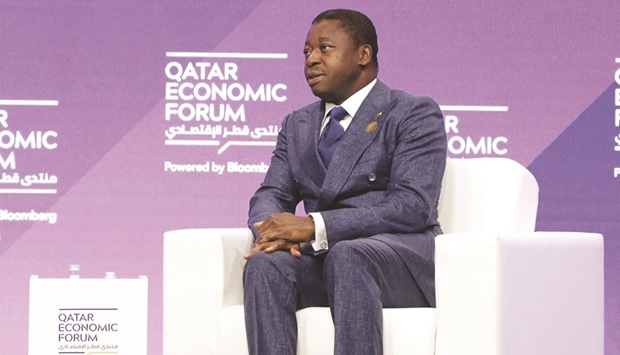
Togo President Faure Essozimna Gnassingbe has said that the West African region suffers from two major problems: high cost of living and security, and pointed out that the inflation in West Africa is very high and reaches the margins of 6%. In a panel discussion entitled 'The Future of Africa' -- within the activities of Qatar Economic Forum 2022, Powered by Bloomberg -- the Togolese president stressed that competition with other countries is a catalyst for improving performance. He also expressed his pleasure in attending the forum and noted his admiration for the level of dialogue and discussion.
Regarding the measures taken by Togo in light of the current situation, he said, measures that are brought in the event of an emergency are to maintain the prices of fuel, wheat, and corn, which costs Togo large sums to stabilise prices, as well as developing strategies in the medium- and long-term, by providing support to the low-income and relying on electric bicycles for transportation, as bicycles are the main means of transportation.
He pointed out that electric bicycles support climate change, as many people use them due to their limited income, noting that buying an electric bicycle is tantamount to buying (a service) only. He added that his country has a national factory to provide this means.
On the impact of conflicts in neighbouring countries on his country, he said that wars have an impact on the humanitarian side, and their cost is high on the economy and their impact also extends to supply chains.
He pointed out that the growth rate of 5.1% before the Covid-19 pandemic was a good indicator. Yet, after the pandemic, and due to limited resources, there was a huge impact on the most vulnerable groups. To protect these groups from the ravages of poverty, the country had to provide these groups with financial support. Education, health, and energy sectors were also supported, as well as the innovation in the fields of water and electricity.
The Togolese president pointed out that there has been an impact on the supply chain due to the pandemic and the current situation in the region and that his country is working to mitigate the crisis by establishing new factories.
Regarding the measures taken by Togo in light of the current situation, he said, measures that are brought in the event of an emergency are to maintain the prices of fuel, wheat, and corn, which costs Togo large sums to stabilise prices, as well as developing strategies in the medium- and long-term, by providing support to the low-income and relying on electric bicycles for transportation, as bicycles are the main means of transportation.
He pointed out that electric bicycles support climate change, as many people use them due to their limited income, noting that buying an electric bicycle is tantamount to buying (a service) only. He added that his country has a national factory to provide this means.
On the impact of conflicts in neighbouring countries on his country, he said that wars have an impact on the humanitarian side, and their cost is high on the economy and their impact also extends to supply chains.
He pointed out that the growth rate of 5.1% before the Covid-19 pandemic was a good indicator. Yet, after the pandemic, and due to limited resources, there was a huge impact on the most vulnerable groups. To protect these groups from the ravages of poverty, the country had to provide these groups with financial support. Education, health, and energy sectors were also supported, as well as the innovation in the fields of water and electricity.
The Togolese president pointed out that there has been an impact on the supply chain due to the pandemic and the current situation in the region and that his country is working to mitigate the crisis by establishing new factories.