


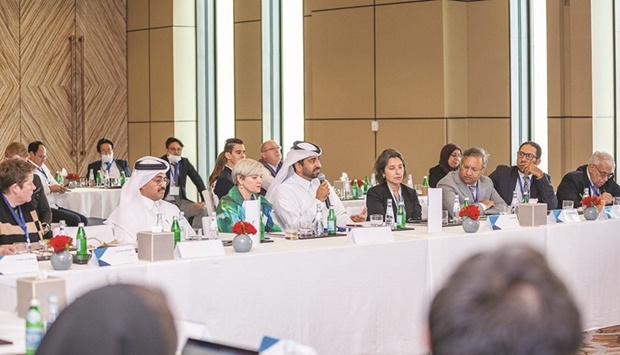
The Qatar Environment and Energy Research Institute (Qeeri), part of Hamad Bin Khalifa University in partnership with Al-Attiyah Foundation, recently held an international workshop on Clean Hydrogen – Qatar’s Role in a Net-Zero World.
Following on Qeeri’s 2020 workshop on The Hydrogen Energy Opportunity for Qatar, the second edition brought together national stakeholders and international experts for discussions around the latest international developments in hydrogen policy and industry that are most relevant to Qatar.
In 2021, Qatar updated its Nationally Determined Contribution under the Paris Agreement on Climate Change, to include its first quantitative carbon emissions reduction target.
It has also formed the Net-Zero Producer Forum with the US, Canada, Norway, and Saudi Arabia.
In this context, clean hydrogen has the potential to help Qatar substantially reduce its domestic emissions as well as the carbon footprint of the fuels and commodities it exports.
The event held with the support of the Qatar National Research Fund (QNRF) recognised the importance of developing clear and effective national strategies, integrated with international collaboration efforts, that aim to overcome technology and market barriers to hydrogen energy opportunities.
Sessions focused on international hydrogen developments and projected future trade, the strategies of other GCC countries, and the most relevant clean hydrogen production and transport technologies for Qatar.
The list of attendees included international experts who work at the Oxford Institute for Energy Studies, the International Renewable Energy Agency (IRENA), Columbia University’s Centre for Global Energy Policy, Ludwig-Bölkow-Systemtechnik GmbH, Worley, Fraunhofer CINES, the Mena Hydrogen Alliance, the Mitsubishi Research Institute, Saipem, Equinor, Chiyoda, and Kawasaki.
Representatives of the oil and gas industry, in addition to other companies operating in Qatar, and the research community also participated in the discussions.
HE Dr Mohamed bin Saleh al-Sada, adjunct professor and chairman of the Joint Advisory Board at Texas A&M University at Qatar, said after attending the event: “I believe that the event successfully sowed a seed for a future regular and wider event on Qatar’s potential hydrogen industry.”
Dr Jayanth Balasubramanian, Carbon Management Research lead at ExxonMobil Research Qatar, said: “Qeeri’s workshop was an important step in promoting the local dialogue on the role of hydrogen in the energy transition.”
The workshop formed part of Qeeri’s commitment, as a national research institute, to supporting Qatar in achieving its strategic energy, environmental, and climate change goals.
Qeeri executive director Dr Marc Vermeersch commented: “Hydrogen will be an important energy carrier in a decarbonised energy system and in helping to cut the emissions of other major sectors.”
“International cooperation should be a decisive part of any comprehensive strategy for scaling hydrogen supply and demand, as well as deploying the required technologies,” he said. “We foresee Qeeri’s innovative research and development supporting Qatar to advance its nascent hydrogen ecosystem.”
In 2021, Qatar updated its Nationally Determined Contribution under the Paris Agreement on Climate Change, to include its first quantitative carbon emissions reduction target.
It has also formed the Net-Zero Producer Forum with the US, Canada, Norway, and Saudi Arabia.
In this context, clean hydrogen has the potential to help Qatar substantially reduce its domestic emissions as well as the carbon footprint of the fuels and commodities it exports.
The event held with the support of the Qatar National Research Fund (QNRF) recognised the importance of developing clear and effective national strategies, integrated with international collaboration efforts, that aim to overcome technology and market barriers to hydrogen energy opportunities.
Sessions focused on international hydrogen developments and projected future trade, the strategies of other GCC countries, and the most relevant clean hydrogen production and transport technologies for Qatar.
The list of attendees included international experts who work at the Oxford Institute for Energy Studies, the International Renewable Energy Agency (IRENA), Columbia University’s Centre for Global Energy Policy, Ludwig-Bölkow-Systemtechnik GmbH, Worley, Fraunhofer CINES, the Mena Hydrogen Alliance, the Mitsubishi Research Institute, Saipem, Equinor, Chiyoda, and Kawasaki.
Representatives of the oil and gas industry, in addition to other companies operating in Qatar, and the research community also participated in the discussions.
HE Dr Mohamed bin Saleh al-Sada, adjunct professor and chairman of the Joint Advisory Board at Texas A&M University at Qatar, said after attending the event: “I believe that the event successfully sowed a seed for a future regular and wider event on Qatar’s potential hydrogen industry.”
Dr Jayanth Balasubramanian, Carbon Management Research lead at ExxonMobil Research Qatar, said: “Qeeri’s workshop was an important step in promoting the local dialogue on the role of hydrogen in the energy transition.”
The workshop formed part of Qeeri’s commitment, as a national research institute, to supporting Qatar in achieving its strategic energy, environmental, and climate change goals.
Qeeri executive director Dr Marc Vermeersch commented: “Hydrogen will be an important energy carrier in a decarbonised energy system and in helping to cut the emissions of other major sectors.”
“International cooperation should be a decisive part of any comprehensive strategy for scaling hydrogen supply and demand, as well as deploying the required technologies,” he said. “We foresee Qeeri’s innovative research and development supporting Qatar to advance its nascent hydrogen ecosystem.”