


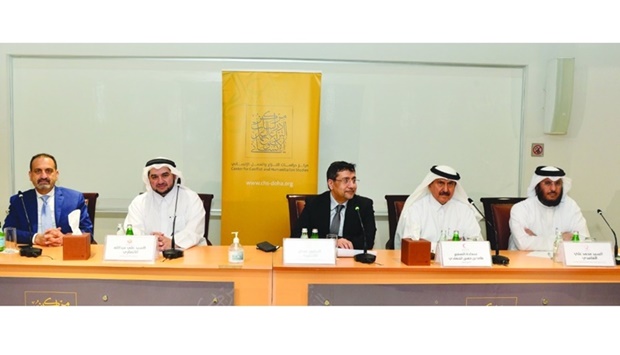
The Center for Conflict and Humanitarian Studies (CHS) and the Regulatory Authority for Charitable Activities (RACA) organised Sunday a joint symposium on 'The Experience of Qatari Humanitarian Organisations in Adapting to a Changing Regional Landscape”, at the Cultural Foundation - Doha Institute for Graduate Studies.
The symposium also shed light on the obstacles being faced by the humanitarian sector. Ali al-Ansari, advisor in the office of the Director-General of the RACA, pointed out that "the interest of the Qatari donor is still focused on basic issues, especially the Palestinian issue, which is the main issue of the Arab nation."
Al-Ansari said that Qatari charitable organisations have not been negatively affected by regional conditions. Especially after the change in the nature of wars in the region, the spread of what is known as the “war on terrorism” and the restrictions placed by many countries on money transfers. He explained that the Qatari community trusts local humanitarian organisations for their lack of dependence on funding from regional countries, and the absence of branches elsewhere in the region, in addition to their good reputation at the international level and the United Nations organisations.
The RACA official pointed out that Qatar's practice in organising charitable work is the best at the Arab level. Qatar established the RACA as a specialised government agency in 2014, and it is gradually getting closer to the level of regulation in countries such as the UK, Canada and Australia.
Qatar government took into account the need to provide the required independence for charitable organisations, with the development of a modern control framework that relies on strengthening regulation, self-compliance of organisations, and the use of digital technologies to monitor the charitable and humanitarian sector, he observed.
Al-Ansari indicated that there are 289 non-profit organisations in Qatar, of which 14 are charitable and humanitarian organisations allowed to collect donations, including Qatar Charity (QC), Qatar Red Crescent Society (QRCS), Silatech, and the Education Above All Foundation. The assets of Qatari humanitarian associations in 2020 amounted to more than QR300mn, while their revenues amounted to QR2.3bn.
In his presentation, the QRCS secretary-general Ali al-Hammadi, said that the issue of politicising humanitarian work is under the influence of the laws against the war on terrorism. “The 9/11 attacks in 2001, were a turning point in humanitarian work, as they constituted a major shake-up with their intellectual and strategic problems, and was also associated with it the criminalisation of humanitarian organisations. In the post-9/11 world, humanitarian work has become accused of terrorism, and some organisations have been exploited in the midst of the fight against terrorism, and many of them have been subjected to restrictions and restrictions."
Al-Hammadi underscored the QRCS’s commitment to its mission to serve people wherever they are, by adopting “humanitarian diplomacy that can be considered as parallel diplomacy.” There is a close relationship between humanitarian work and diplomatic work, as they go hand in hand and facilitate access to crisis and disaster areas through diplomatic relations, material and logistics capabilities, he added.
QC's Governance and Institutional Development Sector assistant CEO Mohammed al-Ghamdi, stressed that "humanitarian work in Qatar is not of a political nature despite the changing regional landscape. Qatar has not put organisations under any pressure in this regard."
In his presentation, the Center for Conflict Studies and Humanitarian Action director Ghassan Kahlout, reviewed a set of variables in the humanitarian work scene after the escalation of crises and wars in the region. He referred especially to refugee crises, climate, economic difficulties, and the change in the role of humanitarian organisations that can no longer reach crisis areas due to the nature of the recent wars, and the interference of military organisations in distributing humanitarian aid in some areas.
Kahlout went on to say that what was known as the war on terrorism led to the restriction of humanitarian activities, and sometimes the criminalisation of some of them. Some humanitarian organisations were forced to deal in some areas with the de facto authorities to deliver aid, which may be considered a terrorist activity. Some organisations had their assets frozen, and the closure of other organisations, which exacerbated the aftermaths of the humanitarian crises.
The symposium also presented future outlooks on opportunities that can be utilised for the benefit of humanitarian actions in the post- Al-Ula era.
The symposium also shed light on the obstacles being faced by the humanitarian sector. Ali al-Ansari, advisor in the office of the Director-General of the RACA, pointed out that "the interest of the Qatari donor is still focused on basic issues, especially the Palestinian issue, which is the main issue of the Arab nation."
Al-Ansari said that Qatari charitable organisations have not been negatively affected by regional conditions. Especially after the change in the nature of wars in the region, the spread of what is known as the “war on terrorism” and the restrictions placed by many countries on money transfers. He explained that the Qatari community trusts local humanitarian organisations for their lack of dependence on funding from regional countries, and the absence of branches elsewhere in the region, in addition to their good reputation at the international level and the United Nations organisations.
The RACA official pointed out that Qatar's practice in organising charitable work is the best at the Arab level. Qatar established the RACA as a specialised government agency in 2014, and it is gradually getting closer to the level of regulation in countries such as the UK, Canada and Australia.
Qatar government took into account the need to provide the required independence for charitable organisations, with the development of a modern control framework that relies on strengthening regulation, self-compliance of organisations, and the use of digital technologies to monitor the charitable and humanitarian sector, he observed.
Al-Ansari indicated that there are 289 non-profit organisations in Qatar, of which 14 are charitable and humanitarian organisations allowed to collect donations, including Qatar Charity (QC), Qatar Red Crescent Society (QRCS), Silatech, and the Education Above All Foundation. The assets of Qatari humanitarian associations in 2020 amounted to more than QR300mn, while their revenues amounted to QR2.3bn.
In his presentation, the QRCS secretary-general Ali al-Hammadi, said that the issue of politicising humanitarian work is under the influence of the laws against the war on terrorism. “The 9/11 attacks in 2001, were a turning point in humanitarian work, as they constituted a major shake-up with their intellectual and strategic problems, and was also associated with it the criminalisation of humanitarian organisations. In the post-9/11 world, humanitarian work has become accused of terrorism, and some organisations have been exploited in the midst of the fight against terrorism, and many of them have been subjected to restrictions and restrictions."
Al-Hammadi underscored the QRCS’s commitment to its mission to serve people wherever they are, by adopting “humanitarian diplomacy that can be considered as parallel diplomacy.” There is a close relationship between humanitarian work and diplomatic work, as they go hand in hand and facilitate access to crisis and disaster areas through diplomatic relations, material and logistics capabilities, he added.
QC's Governance and Institutional Development Sector assistant CEO Mohammed al-Ghamdi, stressed that "humanitarian work in Qatar is not of a political nature despite the changing regional landscape. Qatar has not put organisations under any pressure in this regard."
In his presentation, the Center for Conflict Studies and Humanitarian Action director Ghassan Kahlout, reviewed a set of variables in the humanitarian work scene after the escalation of crises and wars in the region. He referred especially to refugee crises, climate, economic difficulties, and the change in the role of humanitarian organisations that can no longer reach crisis areas due to the nature of the recent wars, and the interference of military organisations in distributing humanitarian aid in some areas.
Kahlout went on to say that what was known as the war on terrorism led to the restriction of humanitarian activities, and sometimes the criminalisation of some of them. Some humanitarian organisations were forced to deal in some areas with the de facto authorities to deliver aid, which may be considered a terrorist activity. Some organisations had their assets frozen, and the closure of other organisations, which exacerbated the aftermaths of the humanitarian crises.
The symposium also presented future outlooks on opportunities that can be utilised for the benefit of humanitarian actions in the post- Al-Ula era.