


ILO Regional Director for Arab States Dr Ruba Jaradat said that the reforms achieved by Qatar in the labour market in recent years, which were implemented in record time and at a rapid pace, were exemplar, stressing that the organisation appreciates and commends the reforms.
In an interview with Qatar News Agency (QNA) on the sidelines of the International Labour Conference in its 110th session currently being held in Geneva, Jaradat stressed the close and continuous co-operation between Qatar and the ILO to further develop all these reforms, with a view to addressing some minor problems in application.
She said that Qatar’s labour reforms are great and have been implemented in record time.
She pointed out that the ILO office in Qatar has been operating in Doha for more than four years.
That period witnessed great progress and a remarkable pace in the labour market, which was a celebration of those achievements that have been and are still being achieved, and the FIFA World Cup Qatar 2022 will also be an opportunity to celebrate these achievements.
She pointed out that Qatar continued with the reforms even in the darkest conditions that the world witnessed during the Covid-19 pandemic. The reform process continued, whether related to the sponsorship system or occupational safety and health and wages, as well as with domestic workers, labour courts, voice of workers, and others.
Jaradat indicated that there are major developments in terms of new laws and policies, and important developments in terms of institutions’ ability to ensure a more effective application of these laws and policies, and to increase partnerships with a large number of stakeholders, especially representatives of workers and employers.
She explained that one of the major achievements so far has been the ability of workers to change jobs without prior consent from their employers. This reform allowed greater labour mobility in the country, improved workers’ conditions, companies have also benefited as they are able to hire workers locally and find workers that better match their needs, and in return Qatar economy benefits from retaining skills and experience within the country.
Jaradat stressed that it is of paramount importance that the reforms taking place align with the Qatar National Vision 2030, which aims to build a more competitive and diversified, knowledge-based economy where the most attractive labour market in Qatar will allow it to compete globally for attracting talent and investment.
She also noted the flourishing of social dialogue and co-operation in the workplace at the enterprise level, as for the first time in the region, there are joint committees with elected representatives of foreign workers to discuss workplace issues with employers, and it has proven to be good for workers and employers, because problems are resolved before they escalate which create more stable and productive workplaces.
Regarding the agreement signed between Qatar and the ILO in 2017, Jaradat said that the evaluation conducted by the organisation for the first phase of technical co-operation for the period 2017/2021 was very positive.
The results of the first phase were officially launched in the presence of all partners and relevant stakeholders who expressed their happiness with the results and achievements made by Qatar in this regard, describing the results achieved in the first phase as “rare”, as she said in this context that the ILO is working in more than 140 countries around the world, and it’s rare to see change happen at this pace.
She explained that the first stage made fundamental changes at the legislative level.
In the first year after the introduction of these reforms, more than 240,000 workers changed their employers, which is a large proportion of the workforce which has changed the dynamic between workers and employers.
Moreover, since the minimum wage was set, more than 280,000 workers (13% of the workforce) have seen their wages increase.
Jaradat also stressed the importance of benefiting from the successful experience of reforms made in the Qatari labour market and generalising them, as there are many good practices that have been followed in Qatar that can be shared with other countries in the region and abroad.
These practices include, for example, setting a minimum non-discriminatory wages which include minimum thresholds for food and housing, while heat stress legislation strengthens worker protections from one of Qatar’s main occupational risks, one that more workers in other regions around the world will face with climate change.
Jaradat expressed the desire to continue long-term co-operation between the two parties through the Regional Office for Arab States.
She spoke about the support provided by the ILO’s regional office, explaining that the organisation has expanded its participation with the government, employers and workers in Arab countries.
The regional office works in 12 Arab countries in Asia to promote social justice and decent work opportunities through sustainable facilities, increasing productivity and growth with equality, saying that this has been achieved through several initiatives and projects, most of which are within the framework of “Decent Work Country Programmes” where the organisation follows a comprehensive and participatory approach in preparation of these programmes.
The projects are agreed upon with tripartite partners (governments, workers and employers organisations) in each country, in line with Sustainable Development Goals — 2030 Agenda and with each country’s national development strategies.
She pointed out that the ILO supports governments, workers and employers in the region in several areas, the most important of which are labour standards and rights, ILO conventions and recommendations, social dialogue, social protection, occupational safety and health, employment and creating decent job opportunities, establishments development, legislation, work regulations, labour policies, expatriate workers, gender equality and non-discrimination, child labour, skills, educational system, vocational and technical training and others.
She explained that the ILO co-operates in this regard with countries experiencing crises and conflicts as well as with neighbouring countries, development partners and donor countries, to increase economic opportunities in these countries and create job opportunities in them by encouraging job-rich national labour plans based on decent work principles.
She said that the Arab region, like other regions in the entire world, has been fundamentally affected by the Covid-19 pandemic over the past two years.
However, the co-operation between the organisation and Arab countries has continued, especially in activities aimed at responding to the challenges of the pandemic. Many achievements have been made during the pandemic to mitigate the effects of the spread of the virus and closures on people’s daily lives.
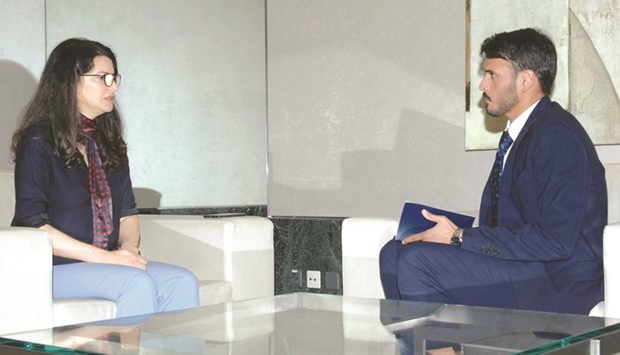
ILO Regional Director for Arab States Dr Ruba Jaradat in an interview with Qatar News Agency.