


The Special Representative of the UN Secretary-General for Children and Armed Conflict, Virginia Gamba, has stressed the solid relations between Qatar and the UN, especially with regard to children and armed conflict, and the importance of raising awareness of the needs of those who suffer from violations in armed conflict, by improving educational initiatives and operations in this field.
In an interview with Qatar News Agency (QNA), Gamba revealed a UN decision to open an analysis and communication centre affiliated with its office in Doha within a week from now, similar to other offices in Europe and elsewhere, in order to accomplish two things, the first of which is to promote the inclusion of forecasts related to mediation and peace operations, as well as training and the issue of dialogue in order to achieve peace, and the second thing is conducting special research to improve knowledge about the new effects that affect children, namely climate change, the coronavirus pandemic (Covid-19) and people with special needs, pointing out that all are now being completed by improving and strengthening the education process in Doha.
She praised the initiatives of Her Highness Sheikha Moza bint Nasser to protect children in areas of armed conflict, saying in this regard, “we commend the amazing roles played by Her Highness Sheikha Moza bint Nasser, especially the initiatives launched by Her Highness with regard to the elimination and prevention of violence against children in conflict areas”.
She added that since the launch of the initiative of Her Highness Sheikha Moza bint Nasser and Qatar Foundation for Education, Science and Community Development, to raise awareness about the need to protect education from attacks, “we have witnessed a UN Security Council resolution on this issue, along with a UN General Assembly resolution, while all members of the UN Security Council and the UN General Assembly agree on ways to protect education from all forms of violence, and this would not have been possible without the initiative of Qatar regarding the education programme”.
She also praised the initiatives of Qatar, which stresses the need to protect educational institutions in areas of armed conflict, as this represents the protection of children in those areas from violations and guarantees education, adding “what we have witnessed since 2011 was that a UN Security Council resolution was issued obligating our office to write reports on these attacks against schools and hospitals, and we used to write reports every year, to emphasize the importance of education”.
She stressed that attacks against educational institutions in areas of armed conflict were a systematic fact against school infrastructure, but she stressed that thanks to the initiative launched by Qatar to prevent all of this from happening, “we are certain that the attack does not fall only on the infrastructure, but on the capabilities of children, to receive sound, free and safe education, and this is directly related to the initiatives to protect children in situations of armed conflict, which were issued under the umbrella of protecting education from attacks, and these initiatives have been expanded to include the UN Security Council”.
She also mentioned that Qatar has done an exceptional job in leading international initiatives, and that it has signed many relevant international treaties and agreements, in addition to its individual initiatives, pointing out that her office is promoting these initiatives, and expressing her hope that other countries will follow the example of Qatar in all these efforts and appreciated initiatives.
On the nature and quality of violations against children in areas of armed conflict, she said: “It is very important to work to prevent violations against children, and we do not fully understand what global measures may occur to prevent these violations against children, and therefore the planned Doha Center will open soon creating specific programmes to see how they will be implemented in this regard,” calling for an end to any violations targeting children, with the importance of providing them with educational opportunities at the same time.
“We know that protecting education from attacks, or banning education for children who have experienced forms of violence, is something that we must stop, and we need to give these children opportunities to learn and choose their way of life, and if we cannot accomplish this, they will be stigmatised, and they will become victims of violations, and therefore, if they are deprived of educational opportunities through integration processes, their suffering will multiply, so it is very important for us to believe in these children, and if they do not receive education, they have no options.”
Regarding the partnership and co-operation between her office and other relevant institutions and organisations regionally and internationally, Gamba said that her office has partnerships with Arab countries, as well as the African Union.
She pointed out that during her last visit to the Egyptian capital, Cairo, this week, the issue of establishing a focal point for the protection of children in conflict areas and the necessary co-ordination with Arab countries was discussed, in order to formulate regional plans to prevent conflicts, including plans for children with disabilities, and children who suffer from the repercussions of climate change and the establishment of training programmes.
She stressed that her office monitors all these practices and works closely with its partners in member states, and through procedural plans, in addition to writing reports and addressing conflicting parties, including regulations related to transitional justice, according to which procedures are formulated that criminalise such violations, as well as activating compensation, rehabilitation and compensation mechanisms for victims, are part of this process.
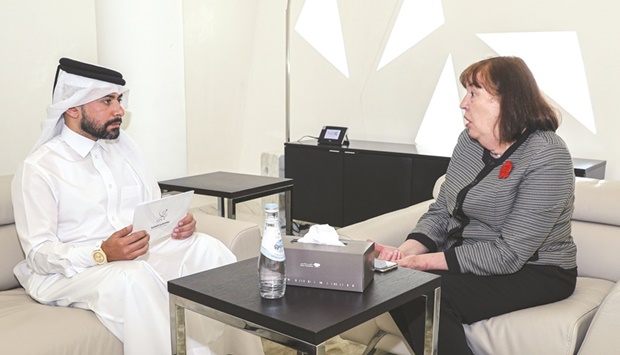
Virginia Gamba speaking to Qatar News Agency.