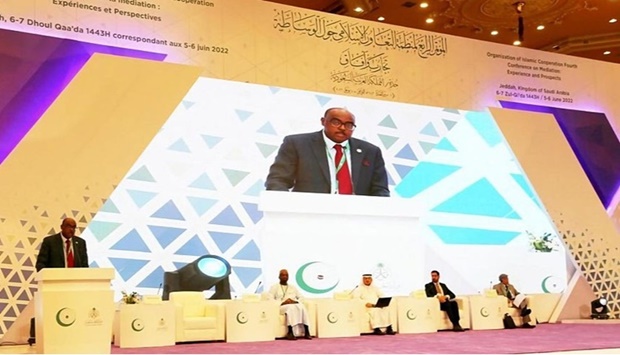
The Fourth Conference of the Organization of Islamic Cooperation (OIC) on Mediation "Experiences and Prospects", organized by the Saudi Ministry of Foreign Affairs in cooperation with the OIC General Secretariat, concluded in Jeddah, Saudi Arabia.
During the conference sessions, the speakers stressed that mediation and good offices represent the best means of settling disputes. They emphasized the need for political will and impartiality, with respect for the sovereignty of states and non-interference in their internal affairs.
The speakers pointed out that Islamic values represent foundational factors in settlement of disputes. They also stressed the importance of taking into account the cultural sensitivities of the parties to mediation, and drawing inspiration from the religious and cultural heritage and the good customs and traditions of the societies affected by these conflicts.
Speakers in the working sessions urged activating the role of women and young people in mediation efforts as well as ensuring the direct participation of groups affected by the conflict, and that the negotiating parties have the leadership of the negotiations during the mediation.
They also called for harnessing information technology and modern technology in mediation processes, identifying the economic, social and political causes of conflict, and for the mediation process to be concurrent with the peace-building process.
The speakers stressed the need for mediation to be multi-dimensional and not focus only on the path of direct dialogue between the two parties to the conflict, but rather extend to include technical and logistical support and training.
Further, they underscored the importance of partnerships between regional and international organizations, given their capabilities and strengths in mediation.
The speakers maintained the importance of mediation alerting the parties to the conflict of the consequences of not reaching a peaceful solution, noting in this regard that the means of pressure and sanctions can contribute to the success of the negotiations. They explained that mediation does not have decision-making power, but rather helps the parties to the conflict to take their decisions.
They urged the mediators to embrace the approach of simplicity and quickness in facilitating between the parties to the conflict, and to use appropriate language that takes into account the positions and viewpoints of the parties, and for mediation to be characterized by readiness, flexibility and consistency.
OIC Assistant Secretary-General for Political Affairs Ambassador Yousif Mohammed Al Dhubaeyi said that the General Secretariat welcomes any new proposal regarding the Mediation Conference and the development of work tools in mediation.
Al Dhubaeyi reviewed the most important ideas and discussions of the conference, referring in this regard to the completion of the Network of Mediators from the OIC Member States, as well as the use of the network of mediators to send fact-finding missions, the development of early warning mechanisms at the national and regional levels, and support for the establishment of centers specializing in mediation study and capacity building.