


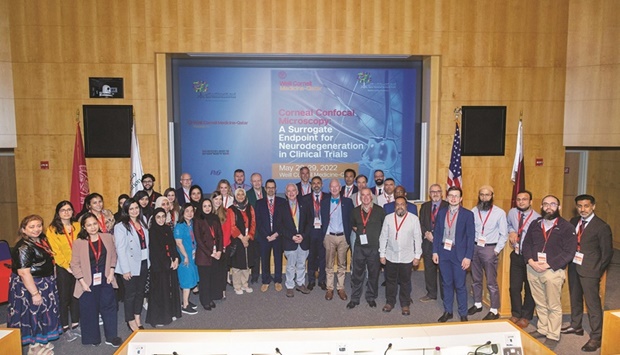
Experts in the pioneering diagnostic technique of corneal confocal microscopy (CCM), which can detect major neurodegenerative disease by examining the small nerves of the eye, gathered at Weill Cornell Medicine-Qatar (WCM-Q) to discuss its use in clinical trials.
The two-day conference supported by the Qatar National Research Fund (QNRF) drew leading experts in CCM from universities, research institutes and hospitals in Qatar, the UK, Italy, Germany, Australia, Singapore, China, Canada, the US and elsewhere to explore the applications of this rapid ophthalmic test in the diagnosis and assessment of treatment effect in various neurodegenerative diseases.
CCM can accurately quantify nerve damage and repair in many central neurodegenerative diseases like Parkinson’s disease, dementia, multiple sclerosis, autism and schizophrenia as well as peripheral neuropathies in patients with diabetes, HIV, and chemotherapy for cancer.
CCM can also be used to investigate nerve damage in amyloid neuropathy, Friedrich’s ataxia, and idiopathic small fibre neuropathy.
Expert speakers at the event discussed a wide variety of topics, beginning with a history of the development of CCM, and ranging through the use of CCM in clinical trials, the potential for using CCM in conjunction with AI (artificial intelligence), and the advantages and challenges of using CCM.
A major issue identified by most speakers was the lack of effective US Food and Drug Administration (FDA) and European Medicines Agency-approved therapies for neurodegenerative diseases, identifying inadequate end points as a major reason for multiple failed clinical trials.
The main theme of the conference was whether CCM could be used as a “surrogate endpoint” in clinical trials of new treatments for neurodegenerative diseases, enabling FDA approval.
WCM-Q speakers at the event included Dr Rayaz Malik, professor of medicine, assistant dean for clinical investigations and a pioneer in the development of CCM; Dr Ioannis Petropoulos, assistant professor of research in medicine; and Dr Georgios Ponirakis, clinical researcher, and lab supervisor.
Other speakers included Professor Andrew Boulton, president of the International Diabetes Federation and professor of medicine at the University of Manchester, UK; Professor Nathan Efron of Queensland University of Technology in Brisbane; Professor Ashfaq Shuaib of the University of Alberta, Canada; Professor Giuseppe Lauria, Professor of Neurology, Milan; and Professor Roy Freeman, director of the Centre for Autonomic and Peripheral Nerve Disorders at Harvard Medical School in Boston.
“The key advantages of CCM is that it is fast, non-invasive and reliably detects neurodegeneration,” said Dr Malik. “We need to make it more widely available and incorporate AI-based technology to diagnose different neurodegenerative diseases and to use it in multi-centre trials of new therapies.”
The conference concluded with agreement on the issuance of a Doha CCM consensus statement – a document identifying the key challenges, opportunities, and actions for the wider adoption of CCM for the assessment of peripheral and central neurodegenerative disease, which is to be submitted for publication in the Journal of the Peripheral Nervous System.
The participants also reached agreement on the establishment of a multi-centre consortium to work collaboratively on studies utilising CCM to investigate peripheral and central neurodegenerative diseases.
CCM can accurately quantify nerve damage and repair in many central neurodegenerative diseases like Parkinson’s disease, dementia, multiple sclerosis, autism and schizophrenia as well as peripheral neuropathies in patients with diabetes, HIV, and chemotherapy for cancer.
CCM can also be used to investigate nerve damage in amyloid neuropathy, Friedrich’s ataxia, and idiopathic small fibre neuropathy.
Expert speakers at the event discussed a wide variety of topics, beginning with a history of the development of CCM, and ranging through the use of CCM in clinical trials, the potential for using CCM in conjunction with AI (artificial intelligence), and the advantages and challenges of using CCM.
A major issue identified by most speakers was the lack of effective US Food and Drug Administration (FDA) and European Medicines Agency-approved therapies for neurodegenerative diseases, identifying inadequate end points as a major reason for multiple failed clinical trials.
The main theme of the conference was whether CCM could be used as a “surrogate endpoint” in clinical trials of new treatments for neurodegenerative diseases, enabling FDA approval.
WCM-Q speakers at the event included Dr Rayaz Malik, professor of medicine, assistant dean for clinical investigations and a pioneer in the development of CCM; Dr Ioannis Petropoulos, assistant professor of research in medicine; and Dr Georgios Ponirakis, clinical researcher, and lab supervisor.
Other speakers included Professor Andrew Boulton, president of the International Diabetes Federation and professor of medicine at the University of Manchester, UK; Professor Nathan Efron of Queensland University of Technology in Brisbane; Professor Ashfaq Shuaib of the University of Alberta, Canada; Professor Giuseppe Lauria, Professor of Neurology, Milan; and Professor Roy Freeman, director of the Centre for Autonomic and Peripheral Nerve Disorders at Harvard Medical School in Boston.
“The key advantages of CCM is that it is fast, non-invasive and reliably detects neurodegeneration,” said Dr Malik. “We need to make it more widely available and incorporate AI-based technology to diagnose different neurodegenerative diseases and to use it in multi-centre trials of new therapies.”
The conference concluded with agreement on the issuance of a Doha CCM consensus statement – a document identifying the key challenges, opportunities, and actions for the wider adoption of CCM for the assessment of peripheral and central neurodegenerative disease, which is to be submitted for publication in the Journal of the Peripheral Nervous System.
The participants also reached agreement on the establishment of a multi-centre consortium to work collaboratively on studies utilising CCM to investigate peripheral and central neurodegenerative diseases.