


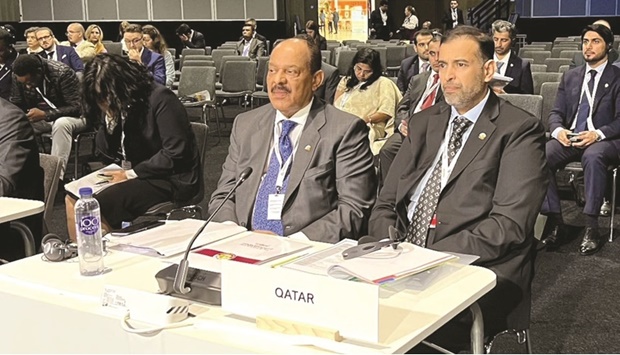
HE the Minister of Environment and Climate Change Sheikh Dr Faleh bin Nasser bin Ahmed bin Ali al-Thani chaired the High-level Segment (HLS) of the meetings of the Conferences of the Parties (COPs) to the Basel, Rotterdam, and Stockholm (BRS) Conventions (BRS Triple COP), currently taking place in the Swedish capital. The meeting, which is held under the theme Global Agreements for a Healthy Planet: Sound Management of Chemicals and Waste., will bring together relevant ministers from around the world to explore opportunities, and promote solutions to address the three environmental crises of pollution, climate change and biodiversity loss, by achieving the objectives of the Basel, Rotterdam and Stockholm Conventions.
The Ministry of Environment and Climate Change said, in a statement, that the aim of the high-level segment of these meetings is to provide an interactive, dynamic and comprehensive platform for ministers to exchange experiences, providing political leadership to renew commitment to the implementation of the three agreements, as well as increasing political awareness and support for them, and encouraging dialogue between them.
It noted that the three interactive ministerial discussions will discuss several sub-topics including pollution, opportunities to address environmental crises represented by pollution, climate change and biodiversity loss, through the implementation of the three mentioned conventions, in addition to the life cycle approach in terms of the opportunities offered by the implementation of these agreements, in order to move towards managing the life cycle of chemicals and waste.
Discussions also include means of implementation in terms of opportunities to enhance the implementation of the three conventions, and through the promotion of new and clean technologies, and innovative approaches to financing. It is noteworthy that the Basel Convention is an international treaty designed to reduce the movements of hazardous waste between countries, specifically to prevent the transfer of hazardous waste from developed countries to less developed countries, and to address the movement of radioactive waste.
The Convention also aims to reduce the quantity and toxicity of waste generated, to ensure environmentally sound management as much as possible, and to assist least developed countries in the environmentally sound management of hazardous waste and other wastes they generate. The Stockholm Convention is concerned with persistent organic pollutants, which is a global treaty to protect human health and the environment from chemicals that remain intact in the environment for long periods.
It is widely distributed geographically, accumulate in the fatty tissues of humans and wildlife, and have adverse effects on human health or the environment.
The multilateral Rotterdam Convention promotes the sharing of responsibilities with regard to the import of hazardous chemicals. It encourages the open exchange of information and invites exporters of hazardous chemicals to put appropriate labels that include guidance on safe handling, and to inform buyers of any known restrictions or prohibitions.
The Ministry of Environment and Climate Change said, in a statement, that the aim of the high-level segment of these meetings is to provide an interactive, dynamic and comprehensive platform for ministers to exchange experiences, providing political leadership to renew commitment to the implementation of the three agreements, as well as increasing political awareness and support for them, and encouraging dialogue between them.
It noted that the three interactive ministerial discussions will discuss several sub-topics including pollution, opportunities to address environmental crises represented by pollution, climate change and biodiversity loss, through the implementation of the three mentioned conventions, in addition to the life cycle approach in terms of the opportunities offered by the implementation of these agreements, in order to move towards managing the life cycle of chemicals and waste.
Discussions also include means of implementation in terms of opportunities to enhance the implementation of the three conventions, and through the promotion of new and clean technologies, and innovative approaches to financing. It is noteworthy that the Basel Convention is an international treaty designed to reduce the movements of hazardous waste between countries, specifically to prevent the transfer of hazardous waste from developed countries to less developed countries, and to address the movement of radioactive waste.
The Convention also aims to reduce the quantity and toxicity of waste generated, to ensure environmentally sound management as much as possible, and to assist least developed countries in the environmentally sound management of hazardous waste and other wastes they generate. The Stockholm Convention is concerned with persistent organic pollutants, which is a global treaty to protect human health and the environment from chemicals that remain intact in the environment for long periods.
It is widely distributed geographically, accumulate in the fatty tissues of humans and wildlife, and have adverse effects on human health or the environment.
The multilateral Rotterdam Convention promotes the sharing of responsibilities with regard to the import of hazardous chemicals. It encourages the open exchange of information and invites exporters of hazardous chemicals to put appropriate labels that include guidance on safe handling, and to inform buyers of any known restrictions or prohibitions.