


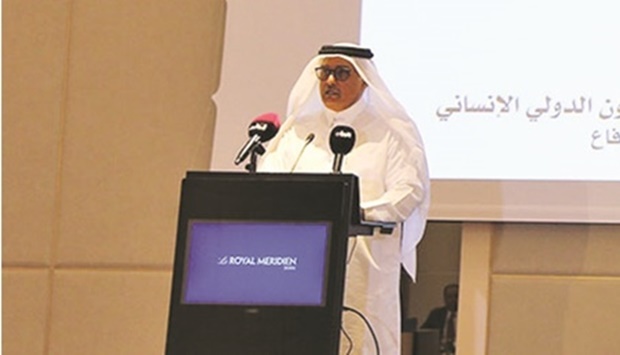
The works of Military Lecturer Program aimed at preparing Qatari military lecturers in the field of international humanitarian law, which is organised by the National Committee for International Humanitarian Law, in co-operation with the Ministry of Defence and the International Committee of the Red Cross, represented by the regional mission of the Gulf Co-operation Council (GCC) started on Thursday.
The seven-day event aims to build and develop Qatari cadres in the field of international humanitarian law, and to disseminate the provisions of this law as widely as possible within the country. In his speech during the inauguration of the work of the program, HE the Minister of Justice Masoud bin Mohamed al-Ameri, stressed that the Qatar attaches great importance to the principles of international humanitarian law and ensure respect for it, through its contribution in many aspects to serve humanity, including education of all kinds in areas affected by armed conflicts, as well as the financial contributions provided by the state, when necessary, to countries in need, or those affected by conflicts or disasters.
HE the Minister noted the keenness of Qatar to contribute to the protection of civilians during armed conflicts without discrimination, by complying with the principles of international humanitarian law, pointing out that, within the framework of implementing this, the National Committee for International Humanitarian Law was established in accordance with Cabinet Resolution No. 27 of 2012 with the aim of consolidating the principles of international humanitarian law at the national level, working to achieve the goals of the international conventions and pacts concluded in this regard, strengthening international co-operation in this field, and publicising these principles at the national level and ensuring their respect.
HE the Minister stressed that what is worrying is the lack of compliance and full implementation of international laws and standards in some international practices, especially those related to international humanitarian law, which leads to the failure to provide protection for defenseless civilians, as well as targeting workers in the humanitarian, relief, medical sectors and media. He pointed out that the most prominent example of this is the assassinations carried out by the Israeli occupation forces against this disarmed group, including the assassination of the journalist, Shireen Abu Aqla, Al-Jazeera correspondent, at the hands of the brutal Israeli occupation, which is a clear example of the flagrant violation of the principles of international humanitarian law, and the blatant violation of international humanitarian law, the freedom and the right of peoples to access information.
HE the Minister also noted the keenness of the Ministry of Justice, based on Qatar National Vision 2030, which made human development one of its pillars, to invest in the human cadres, whether through the different and specialised courses offered by the Center for Legal and Judicial Studies for jurists in government agencies and other entities, or through the efforts of the National Committee for International Humanitarian Law. He called on the participants of the Ministry of Defence in this program to take advantage to meet the goals and ambitions of the National Committee for International Humanitarian Law to obtain elite Qatari military lecturers after the end of the program stages, in order to benefit from them in the present and the future.
For his part, HE the Undersecretary of the Ministry of Justice and Chairman of the National Committee for International Humanitarian Law Sultan bin Abdullah al-Suwaidi, affirmed the committees' interest, since its establishment in 2012, in consolidating and disseminating the principles of international humanitarian law, whether at the national or Arab and international levels. He pointed out that the establishment of this committee came as a reflection of the directives of the wise leadership of His Highness the Amir Sheikh Tamim bin Hamad al-Thani, and in consolidation of the approach of Qatar, for which the world witnessed persistent and responsible humanitarian effort to resolve conflicts, banish the spectre of wars, rescue victims, and remove the destruction left behind, which embodies the seriousness of Qatar in its humanitarian endeavour.
He also referred to the committee's activities with various parties, such as the 'Qatari Lecturer Program' aimed at preparing lecturers in the field of international humanitarian law, and it is presenting the idea of the Military Lecturer program, through which it seeks to prepare military lecturers at the Ministry of Defence, selected from various agencies in the ministry.
The seven-day event aims to build and develop Qatari cadres in the field of international humanitarian law, and to disseminate the provisions of this law as widely as possible within the country. In his speech during the inauguration of the work of the program, HE the Minister of Justice Masoud bin Mohamed al-Ameri, stressed that the Qatar attaches great importance to the principles of international humanitarian law and ensure respect for it, through its contribution in many aspects to serve humanity, including education of all kinds in areas affected by armed conflicts, as well as the financial contributions provided by the state, when necessary, to countries in need, or those affected by conflicts or disasters.
HE the Minister noted the keenness of Qatar to contribute to the protection of civilians during armed conflicts without discrimination, by complying with the principles of international humanitarian law, pointing out that, within the framework of implementing this, the National Committee for International Humanitarian Law was established in accordance with Cabinet Resolution No. 27 of 2012 with the aim of consolidating the principles of international humanitarian law at the national level, working to achieve the goals of the international conventions and pacts concluded in this regard, strengthening international co-operation in this field, and publicising these principles at the national level and ensuring their respect.
HE the Minister stressed that what is worrying is the lack of compliance and full implementation of international laws and standards in some international practices, especially those related to international humanitarian law, which leads to the failure to provide protection for defenseless civilians, as well as targeting workers in the humanitarian, relief, medical sectors and media. He pointed out that the most prominent example of this is the assassinations carried out by the Israeli occupation forces against this disarmed group, including the assassination of the journalist, Shireen Abu Aqla, Al-Jazeera correspondent, at the hands of the brutal Israeli occupation, which is a clear example of the flagrant violation of the principles of international humanitarian law, and the blatant violation of international humanitarian law, the freedom and the right of peoples to access information.
HE the Minister also noted the keenness of the Ministry of Justice, based on Qatar National Vision 2030, which made human development one of its pillars, to invest in the human cadres, whether through the different and specialised courses offered by the Center for Legal and Judicial Studies for jurists in government agencies and other entities, or through the efforts of the National Committee for International Humanitarian Law. He called on the participants of the Ministry of Defence in this program to take advantage to meet the goals and ambitions of the National Committee for International Humanitarian Law to obtain elite Qatari military lecturers after the end of the program stages, in order to benefit from them in the present and the future.
For his part, HE the Undersecretary of the Ministry of Justice and Chairman of the National Committee for International Humanitarian Law Sultan bin Abdullah al-Suwaidi, affirmed the committees' interest, since its establishment in 2012, in consolidating and disseminating the principles of international humanitarian law, whether at the national or Arab and international levels. He pointed out that the establishment of this committee came as a reflection of the directives of the wise leadership of His Highness the Amir Sheikh Tamim bin Hamad al-Thani, and in consolidation of the approach of Qatar, for which the world witnessed persistent and responsible humanitarian effort to resolve conflicts, banish the spectre of wars, rescue victims, and remove the destruction left behind, which embodies the seriousness of Qatar in its humanitarian endeavour.
He also referred to the committee's activities with various parties, such as the 'Qatari Lecturer Program' aimed at preparing lecturers in the field of international humanitarian law, and it is presenting the idea of the Military Lecturer program, through which it seeks to prepare military lecturers at the Ministry of Defence, selected from various agencies in the ministry.