


Hours after President Vladimir Putin announced Russia’s invasion of Ukraine, Aeroflot PJSC’s top executives gathered at the airline’s headquarters down the street from the Kremlin.
In the official part of the surreal board meeting, they discussed the flagship Russian carrier’s budget without mentioning the war or any risks it might create, according to two people familiar with the proceedings who asked not to be identified because they weren’t public. But on the sidelines, some executives found little beyond curse words to describe the airline’s prospects, one of the people said.
Within weeks, the company’s top executive, the head of its low-cost unit and its strategy chief would resign their posts.
Aeroflot succeeded over the last two decades in turning itself from a punchline about Communist-era service into an award-winning international carrier flying one of the youngest fleets in the world. It now faces a future that looks much like its Soviet past and, with its Boeing Co and Airbus SE jets cut off from parts and service, it is shifting its focus to domestic routes and locally produced planes as the impact from unprecedented economic sanctions on Russia becomes clearer.
“Aeroflot was built up to a global standard but will be a shadow of itself, able to fly only to those parts of the world willing to do business with Russia,” said Christopher Granville of London-based consultancy TS Lombard. “This is a mirror for the Russian economy as a whole, now cut off from the Western-led economic system.”
Aeroflot’s press service did not respond to a request to comment on the board meeting or its prospects. Aeroflot had been a flagbearer of Putin’s Russia Inc, demonstrating a state-owned company could offer first-rate service in the competitive international travel industry. Since the war began, it’s problems have become a symbol of Russia’s isolation. In March, in response to a European Union order to repossess planes leased to Russian airlines, Putin authorised the seizure of leased commercial aircraft. Aeroflot in short order halted all international flights except to Belarus. It has since cautiously restarted service to 13 countries, down from 56 before the war, most recently to the Maldives.
The measures have taken a toll, with the number of international passengers Aeroflot Group carried in March down by half from a year earlier to 189,000.
The pain will likely get worse. The vast majority of the group’s more than 350 planes are Airbus or Boeing models, and it is facing a looming parts deficit. Aviation data specialists IBA estimate Russian airlines have supplies to last three months and then may start cannibalising aircraft for parts.
A push to replace imports with Russian-built passenger planes championed by Putin since his first term can’t compensate for the shortfall. The regional Sukhoi Superjet, which has had two fatal accidents in the last decade, relies on an engine made in partnership with France’s Safran SA.
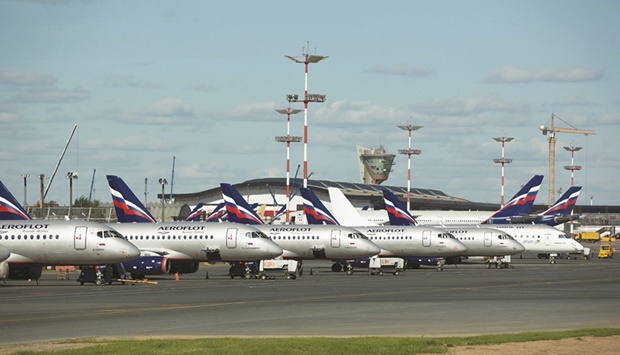
Sukhoi Superjet 100-95 passenger jets, operated by Aeroflot, at Sheremetyevo in Moscow. Aeroflot now faces a future that looks much like its Soviet past and, with its Boeing and Airbus jets cut off from parts and service, it is shifting its focus to domestic routes and locally produced planes as the impact from unprecedented economic sanctions on Russia becomes clearer.