


The benchmark Philippine stock index dropped amid a global selloff, as investors awaited economic plans of Ferdinand Marcos Jr who, based on an unofficial count of Monday’s vote, was headed for a landslide win in the presidential election.
The Philippine Stock Exchange Index ended 0.6% down at 6,720.93, its lowest close in nine months. It fell as much as 3.1% earlier. Nineteen of the benchmark’s 30 components declined, with Converge Information and Communications Technology Solutions Inc, AC Energy Corp and Robinsons Land Corp leading the losses.
Equities are unlikely to rally until Marcos lays out a plan to spur growth, tame inflation and address the nation’s ballooning debt, according to analysts. The slide in the benchmark gauge also reflects losses in regional shares as rising U.S. interest rates and slowing Chinese growth hurt sentiment.
“Marcos has to form his economic team right away to provide local market stability,” said Manny Cruz, a strategist at Papa Securities. “Without an economic team and pronouncements on his economic agenda, it will be difficult to see a rally for investors will be reacting mainly to global headwinds.”
Based on the broader Philippine Stock Exchange All Share Index’s loss of up to 2.9%, the selloff on Tuesday erased as much as 488bn pesos ($9.3bn). Market capitalisation dropped by 168.27bn pesos at the close.
PhilWeb Corp, an operator of bingo parlours, jumped 31%, leading gains among stocks seen as having ties to Marcos. PhilWeb has gained 80% in five sessions.
Over a longer time line, losses in the nation’s equities pale in comparison to the declines in regional shares. The Philippine Stock Exchange Index has fallen 5.6% this year, outperforming the MSCI AC Asia Pacific Index which dropped more than 17%.
Here’s what analysts are saying:
Manny Cruz, strategist, Papa Securities
*Investors should take the opportunity to position amid pullbacks as Marcos will have a “super majority” in Congress, allowing him to push through legislation to boost economic growth and attract foreign investments.
*In the short to medium term, stocks will track the gains posted in 2016 when Rodrigo Duterte was elected and equities rallied when he named his economic team and presented his economic and fiscal agenda.
Robert Ramos, head of the trust and investments group at Rizal Commercial Banking Corp
*A key topic is the nation’s debt to GDP, which is “quite high compared with the last six years.”
*Marcos and his economic team must also allay foreign investors’ fears by assuring them that contracts and agreements reached here and abroad will be honoured.
*“Foreign investors would also like to hear assurances that clean and transparent governance will be pursued. If those fears are allayed, they might decide to buy into the Philippines.
*The biggest headwind for the Philippines is that it’s a consumer-driven economy that is not on a high note.
Jonathan Ravelas, chief market strategist, BDO Unibank
*“The surveys have already flagged this outcome” and the market will take this result as credible.
*Investors will stay on the sidelines until the new president provides a clear and concrete plan to tackle rising poverty, strengthen health care, deal with inflation and manage debt.
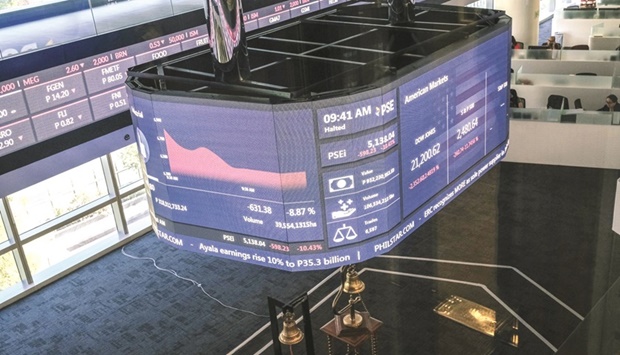
Bells stand under an electronic board displaying stock figures on the trading floor of the Philippine Stock Exchange in Bonifacio Global City (BGC) Metro Manila, the Philippines.