


Egypt is looking to attract more visitors from Latin America and Asia while enabling new international flights to a main resort as it tries to limit the blow to its key tourism industry from Russia’s invasion of Ukraine.
With the conflict jeopardising the flow of Russian and Ukrainian arrivals that made up 30%-40% of Egypt’s total, authorities are also seeking to speed the return of European nations who mostly stayed away during the pandemic, Deputy Tourism Minister Ghada Shalaby said in an interview last week.
“Expectations for Egyptian tourism in 2022 are not higher than last year,” she said, declining to give projections. The North African nation’s tourism revenue was $5.8bn in the second half of 2021, up from $1.8bn for the same period the year before, central bank data showed last week.
Turbulence in Egyptian tourism would add to economic pressures for the Arab world’s most populous nation, which is wrestling with higher food and energy prices as a result of the conflict and has turned to the International Monetary Fund for support.
Along with Suez Canal receipts and remittances, the sector has traditionally been one of Egypt’s prime foreign-currency earners.
New international flights to the Red Sea resort of Sharm El Sheikh from Gulf nations could also provide a boost, Shalaby said. A restart of daily Cairo-Moscow flights after several weeks’ suspension “will help in regaining some of what we lost,” as will limited services from Russia to Egypt’s Red Sea resorts, Shalaby said. Russian investors may also increase their activity in the tourism sector after the enactment of a new law allowing foreign investment in South Sinai, according to the deputy minister.
In the longer term, Latin American nations like Brazil essentially represent a new market for Egypt, she said.
Other markets being targeted include India, Pakistan, Morocco, Algeria and Gulf States like Bahrain, Qatar and Kuwait, Shalaby said. Discussions are underway or planned with Germany, France, the UK, Italy, Poland and Estonia on how to bolster visits.
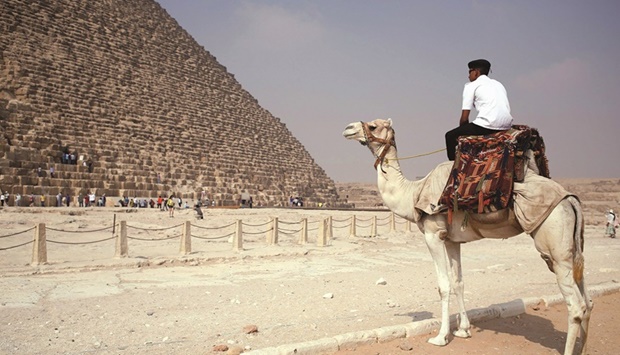
A policeman rides a camel while guarding the site at the pyramids plateau in Egypt (file). Along with Suez Canal receipts and remittances, the tourism sector has traditionally been one of Egypt’s prime foreign-currency earners.