


Governor of Al Quds Adnan Ghaith has said there were clear indications that the Israeli occupation and settlers would like to divide Al-Aqsa Mosque, stressing the Palestinian people will spoil these plans with their resistance.
Ghaith told Qatar News Agency that the Israeli occupation is imposing a temporal division, by allowing extremists to storm into the mosque daily from 7am-10am, providing them with complete protection. He said the temporal division of Al-Aqsa refers to allocating specific times every day for Jewish extremists to enter the mosque.
As for the spatial division, he said there are intentions to carve out parts of the mosque on a permanent basis, making extremists partners in praying in the mosque. He said there was a public plan from one of the Zionist organisations that began the search for an architect that would take out part of the mosque to separate it from the rest of it.
He said the occupation has been preventing any renovation in Al-Aqsa, with excavations taking place underneath the mosque for decades. He stressed that Al-Aqsa Mosque is a central issue for Arabs and Muslims, not just Palestinians. He said the entire Arab and Muslim nation must assume their responsibility in facing the occupation. He also stressed the right of the Palestinian people to worship without obstacles, especially during the holy month of Ramadan.
Ghaith said the occupation began arresting Palestinians at Al-Aqsa mosque before Ramadan, adding the occupation had a plan for Al-Aqsa Mosque during Ramadan this year, because it coincided with Jewish holidays. He also said that extremist organisations continue to call, through social media, for the storming into Al-Aqsa Mosque, highlighting
that the mosque has always been a target for Israel.
Ghaith, who was arrested by the occupation forces more than 30 times since he became governor in 2018, described current events as a battle taking place in all of Al Quds, and at Al-Aqsa Mosque in particular. He said Al Quds was completely surrounded and that the occupation sought to carve the city out of its Palestinian surrounding through a segregation wall. He said the occupation’s authority were preventing the people of the West Bank and Gaza from entering Al Quds, unless they could obtain a permit from the occupation. He said other actions like connecting settlements with a network of roads have made Al Quds secluded from other Palestinian governorates.
He said while Muslims worldwide were celebrating Ramadan, citizens of Al Quds were either on trial or at the cemeteries bidding farewell to their martyrs. He highlighted that the occupation has a history of violating laws and resolutions, whether from the UN Security Council or other UN bodies like the Unesco.
The governor of Jerusalem criticised the international community’s double standards with regard to the Palestinians. He highlighted that at a time when the world is standing up to Russia for its war on Ukraine, the Palestinian people have not seen such support despite the ongoing aggression from the Israeli occupation.
Ghaith said Palestinians have always suffered aggression, setbacks, and tragedies and entire neighbourhoods were now being forcibly removed for a third time, like the Sheikh Jarrah and Silwan neighbourhoods in occupied Al Quds. Ghaith said more than 120 Palestinian institutions in the city were closed. He stressed Palestinians deserved to live with dignity, wondering why there were no international resolutions to help achieve that goal. He highlighted that the goal of the occupation from the aggression is to push citizens of Al Quds to leave the city. He added that citizens of Al Quds understand that and that’s why they continue to try and protect their land.
On the UN Security Council session held to discuss developments in Al Quds, the Palestinian official concluded his remarks by saying they welcome any strong position taken by any institution from the criminal actions of the occupation in the occupied land. He maintained however that the occupation forces have always turned their back on international institutions, and rely on an American veto to protect them at the Security Council.
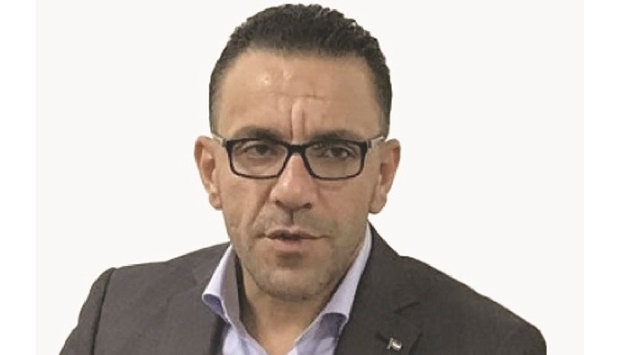
Governor of Al Quds Adnan Ghaith.