


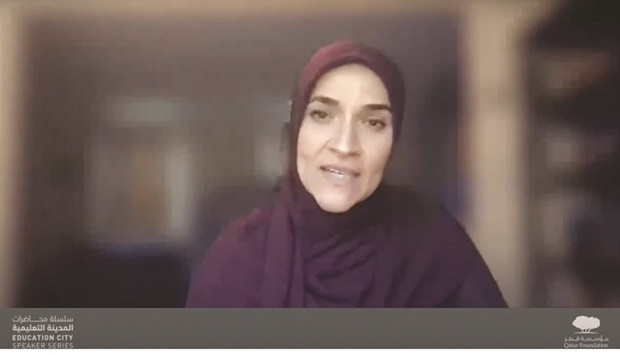
Ramadan must be the “spiritual fuel” for people to work for “a better, more just, more compassionate society”, a leading researcher on the Muslim world has told a special edition of Qatar Foundation’s Education City Speaker Series.
Outlining why she believes the Holy Month should be about “solidarity, spiritual growth, and social justice,” Dalia Mogahed, director of research at the Institute for Social Policy and Understanding, an organisation that leads research into American Muslims’ challenges and opportunities – told the global dialogue platform how Ramadan can instill a sense of “experiential empathy” that acts as a source of inspiration for serving humanity.
The online discussion also explored misconceptions about the meaning of Ramadan, and what was temporarily lost during the Holy Month over the past two years due to Covid-19 restrictions on gatherings, before being regained this year.
“Ramadan restrains and places under control the drives that lead to the opposite of justness and compassion – oppression, usurping other people’s rights, greed, lust for power, unchecked anger,” Mogahed, said. “All of these are things we are meant to learn to master during this 30-day spiritual ‘bootcamp’, and by harnessing this spiritual energy, we should feel inspired to work for a more just society.
“What Ramadan also teaches us is what it feels like to be hungry. Many of us never have to feel this except when fasting, while others experience it every day. When we have this experiential empathy for those who may go hungry all year round, it can inspire us in a way that would not have happened had we not felt it.
“Experiential empathy is gained by experiencing someone else’s struggle yourself, rather than just hearing about it. The thirst and hunger of Ramadan can truly transform how we think about investing in alleviating suffering. In theory, we all want to better commit to social justice, but when we taste a little hardship ourselves, it triggers something inside us where we have a different level of commitment.”
During the discussion – moderated by Sulaiman Bah, community engagement and outreach co-ordinator at Minaretein, Mogahed, who is also the CEO of Mogahed Consulting, explained that the “deep spiritual transformations” that can happen during Ramadan can go unrecognised by those not observing it.
“If the true essence of Ramadan and all its aspects – of which fasting is just one – were better understood, there would be greater respect and admiration for this time of year.”
And she described the Holy Month as “a time of preparation for the rest of the year”, saying: “We should not let this month end without making a reinvestment in service – social justice is all about service.”
The online discussion also explored misconceptions about the meaning of Ramadan, and what was temporarily lost during the Holy Month over the past two years due to Covid-19 restrictions on gatherings, before being regained this year.
“Ramadan restrains and places under control the drives that lead to the opposite of justness and compassion – oppression, usurping other people’s rights, greed, lust for power, unchecked anger,” Mogahed, said. “All of these are things we are meant to learn to master during this 30-day spiritual ‘bootcamp’, and by harnessing this spiritual energy, we should feel inspired to work for a more just society.
“What Ramadan also teaches us is what it feels like to be hungry. Many of us never have to feel this except when fasting, while others experience it every day. When we have this experiential empathy for those who may go hungry all year round, it can inspire us in a way that would not have happened had we not felt it.
“Experiential empathy is gained by experiencing someone else’s struggle yourself, rather than just hearing about it. The thirst and hunger of Ramadan can truly transform how we think about investing in alleviating suffering. In theory, we all want to better commit to social justice, but when we taste a little hardship ourselves, it triggers something inside us where we have a different level of commitment.”
During the discussion – moderated by Sulaiman Bah, community engagement and outreach co-ordinator at Minaretein, Mogahed, who is also the CEO of Mogahed Consulting, explained that the “deep spiritual transformations” that can happen during Ramadan can go unrecognised by those not observing it.
“If the true essence of Ramadan and all its aspects – of which fasting is just one – were better understood, there would be greater respect and admiration for this time of year.”
And she described the Holy Month as “a time of preparation for the rest of the year”, saying: “We should not let this month end without making a reinvestment in service – social justice is all about service.”