The Russian military operation in Ukraine is close to completing its second month. Their forces moved forward towards achieving specific goals, which is the “disarmament” of Ukraine, the imposition of sovereignty over the Crimea region, as well as the support and securing of the Donetsk and Luhansk regions after declaring their secession from Ukraine, while the Ukrainian forces are struggling to defend their country and protect its sovereignty and territorial integrity, denouncing the Russian claims for launching the war, and accusing the Russian forces of committing “atrocities” against Ukrainian civilians.
The negotiation rounds that took place between Moscow and Kyiv so far have not yielded any tangible results, and it does not appear that there is a diplomatic solution on the horizon that can stop the war and its ugliness on civilians and innocents.
Various countries are making efforts to try to stop the war or alleviate the suffering of civilian and innocent victims. There are other countries that offered to mediate in the negotiations, and there are those who announced the provision of humanitarian aid to Ukrainian refugees, such as Qatar, which announced last week the allocation of $5mn to support Ukrainian refugees and displaced persons, based on its moral responsibility.
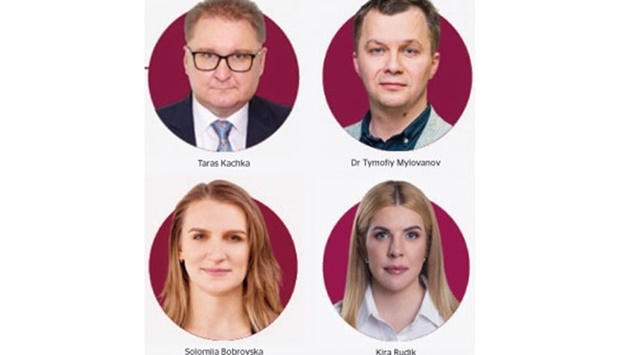
In exclusive statements to Qatar News Agency (QNA), Deputy Minister of Economy of Ukraine Taras Kachka expressed his great appreciation for the Qatari support, saying that there are more than 4mn Ukrainians living abroad now, and more than 7mn are internally displaced, so “Qatar’s support is of great importance to us.”
Kachka added: “For us, we would like to see the participation of the Gulf states and the entire Arab world in resolving the crisis that is happening to us now. It is important for the whole world to shed light on the Ukrainian crisis; help solve it and resume our normal activities. This will only happen if the Russian aggression stops.”
Kachka stressed that the participation of Ukrainian President Volodymyr Zelensky and other officials of the Ukrainian Foreign Ministry in the Doha Forum, which was held in Doha in March, had a positive resonance in presenting and talking about the Ukrainian issue, explaining that President Zelensky’s participation contributed a lot to introducing people in the Middle East and the Arab world to the Ukrainian crisis.
He pointed out that for Ukraine, strengthening co-operation with Qatar and Gulf states in general was already gaining great importance even before the Russian aggression.
He stressed that the Russian military operation had greatly damaged not only the Ukrainian economy, but the economy of the region, and even the economy of Russia itself.
He felt the economic assessments change all the time, but they are “gloomy and negative” now, pointing out that in the secured areas in Ukraine — in the centre and west of the country — the economy is resilient to some extent, and the planting work there has almost begun, which is good for the harvest in the future. The logistics services on the western border are improving, which is also a good thing, he added.
Kachka believes the Western sanctions will have significant effects on the Russian economy in the long run, calling for the sanctions to be expanded to include all sectors in Russia, especially the oil and gas sector.
“We believe that the only way to tighten sanctions is to target the Russian oil and gas sector, because this sector constitutes about 30% of the revenues of the Russian economy. These revenues go to support the army, that is why we believe that it is necessary to go immediately to target the oil and gas sector in Russia, and then we can talk about any mediation efforts to resolve the conflict,” he said.
He said his country has received great support from the European Union as well as from the IMF for its financial systems, explaining that Ukraine also needs a lot of support to help it overcome the negative economic effects of the war on future generations and for the coming years.
President of the Kyiv School of Economics and former minister of economic development Dr Tymofiy Mylovanov described the current situation in Ukraine as “tragic.”
Mylovanov said: “The killings and extrajudicial executions committed by the Russian forces in Ukraine amount to war crimes,” stressing that the situation is very difficult on the humanitarian front, psychologically and morally.
About the economic situation, he stressed that the war has a huge economic cost to Ukraine, and that the country will need many years to return its economy to normal.
Mylovanov explained that the direct losses in the infrastructure are estimated at $100bn, in addition to corporate and human capital losses, which will need huge funds, noting that the return of things to normal will depend on when the funds will be available, and the amount of support that will be provided to Ukraine in this regard.
He also pointed out that the recovery process will depend on the return of migrants and refugees to their country, underlying that 80% of those who have been displaced and migrated inside and outside the country will return at the first opportunity available to them.
Regarding negotiations between Moscow and Kyiv, Mylovanov said: “It would be good to stop war crimes until the negotiations achieve their goal.” He expressed scepticism about the possibility of achieving progress through negotiations, but added: “We must continue negotiations in the hope that something good will happen.”
Ukrainian parliamentarian and Secretary of the Foreign Affairs Committee Solomiia Bobrovska said that despite the withdrawal of Russian forces from the Kyiv, what they left behind after weeks of war are “hundreds of thousands of civilian deaths, and many who were subjected to assaults, especially women.”
Bobrovska added the atrocities and killings carried out by the Russian forces amounted to “genocide” against the Ukrainians. “We expect the International Court of Justice to punish the Russians for their violations and atrocities committed against Ukrainian civilians,” she said.
She pointed out that the situation in the besieged city of Mariupol is tragic, explaining, “If you look at the city about two months ago and look at it now, you will almost not recognise it. The infrastructure has been destroyed, and the city has become one of the hottest spots in Ukraine.”
Regarding the negotiations between Moscow and Kyiv, Bobrovska said: “Unfortunately, we are not optimistic about reaching agreements during the next rounds of negotiations,” calling on Russia to withdraw its forces from Ukraine immediately.
Bobrovska expressed her hope that the allied countries will continue their military aid to Ukraine, as well as support through sanctions against Russia, noting that there are European countries that still provide Kyiv with equipment and weapons and provide it with support, such as Germany, France, The Netherlands and others, and there are other countries preferred to remain neutral.
Another parliamentarian and leader of the Golos party Kira Rudik said that despite the success of the Ukrainian forces in repelling the Russian forces and pushing them out of the Kyiv region, “scattered bodies and destroyed houses” were found everywhere.
“We will do everything in our power to ensure that everyone responsible for these acts is held accountable,” she vowed.
She pointed out that Ukraine had been at war with Russia for eight years, and what can be expected is that there will be countries that give security guarantees, and then “we can talk to President Putin.”
She also called for Russia to be expelled from all international organisations with influence to isolate it, saying: “We need to ensure that (what is happening in Ukraine) never happens again in the world.”