


Ratings agency Fitch revised its outlook on Saudi Arabia to “positive” from “stable” on Thursday, citing improvements in the country’s sovereign balance sheet given higher oil revenues.
Saudi Arabia expects to post its first budget surplus in nearly a decade this year by keeping a tight rein on its budget while revenues roll in, boosted by higher crude prices, Finance Minister Mohamed al-Jadaan said in December.
The kingdom has increasingly relied on its $450bn sovereign wealth fund, the PIF, and other state entities to drive an ambitious spending push — leaving the government’s books relatively clear while freeing it to raise debt if needed.
S&P last month also raised Saudi Arabia’s outlook to positive from stable.
“Government debt/GDP and sovereign net foreign assets (SNFA) will remain considerably stronger than the ‘A’ median, even as these metrics weaken mildly after 2022 as oil prices trend lower offsetting further gradual budgetary reforms,” Fitch said.
The Saudi government plans to keep its debt stock unchanged this year, with new issues used mostly to refinance maturing debt rather than to support the budget.
Jadaan said in December: “In total, actually the numbers are higher than what we used to spend, but the scope is a lot bigger.” The kingdom expects 7.4% GDP growth this year after the economy rose 3.2% last year as oil prices rose and it recovered from the Covid-19 pandemic’s impact.
GDP had contracted 4.1% in 2020.
Separately, Saudi Arabia’s consumer price index rose 2% in March from a year earlier on the back of rising transport and food costs, increasing for the seventh consecutive month, government data showed on Thursday.
Food and beverages rose 3% compared to a year earlier, driven by a 2.4% rise in meat prices and 9.4% in vegetable prices, the General Authority for Statistics said in a statement.
James Swanston, Middle East and North Africa economist at Capital Economics, said he expected inflation to continue strengthening over the coming months as food prices continue to rise, in part due to the war in Ukraine.
He expects inflation to peak around 2.5% in the third quarter before coming back down to between 1% and 1.5% by 2023 or 2024.
“The increase in inflation was broad-based across most major price categories,” he wrote in a research note. “Despite rising global energy prices, local fuel prices have been kept capped at last July’s level, resulting in a slowdown in fuels and lubricants inflation. Meanwhile, housing and utilities inflation was pushed higher by stronger rents.”
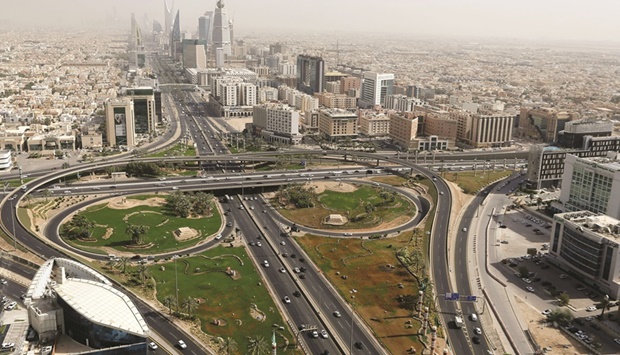
A general view of Riyadh. Saudi Arabia expects to post its first budget surplus in nearly a decade this year by keeping a tight rein on its budget while revenues roll in, boosted by higher crude prices, Finance Minister Mohamed al-Jadaan said in December.