


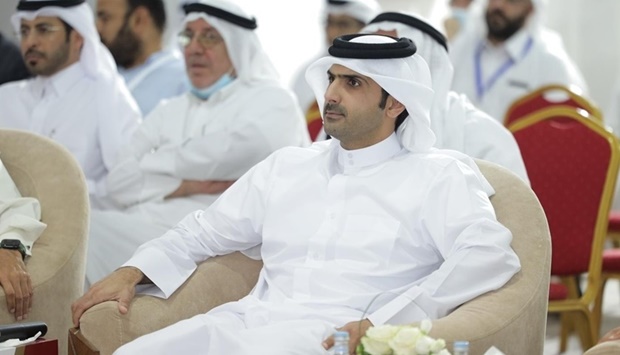
* Countries develop as much as they are proud of their language and the real intellectual is the one who cherishes his language, HE the Minister of Culture Sheikh Abdulrahman bin Hamad al-Thani, affirmed in a statement after a lecture on Arab culture at Al Jasra Cultural and Social Club on the sidelines of the Ramadan Book Fair currently being held in Souq Waqif.
HE the minister valued the role of Al Jasra Club in enriching the cultural life in Qatar, stressing that the ministry is completing the edification process.
Dr Abdullah Faraj al-Marzouki, started his presentation by providing an idiomatic and linguistic definition of culture. “Certainly, it is a loose word like a bird with two wings, but it has no home.”
He discovered that culture is an updated word, and “it did not get its right in linguistic dictionaries, except to attain a definition for it that it means sciences, human principles, moral values, and all that human beings need” by reference to al-Waseet Dictionary.
Dr al-Marzouki elucidated that because Qatar is an integral part of the Arab nation, it has adapted and coexisted with the Arab culture. He emphasised that the Arab culture is based on two pillars, the Arabic language and the true religion, and that the language is the common denominator for all Arabs, just as the Holy Qur’an unites all Muslims in all parts of the world, to form together an Arab and Islamic culture.
The presenter stressed the characteristics of the Arabic language. He affirmed that it is one of the oldest languages, and that while dialects overlap with it, they did not affect it. Referring in this context to some Qatari dialects, which he underlined that were derived from the classical Arabic language. He gave the example of the word "Ghabga", which is a standard Arabic word (For the Gulf people, "Ghabga" means the late Ramadan dinner, which precedes the Suhour meal).
Dr al-Marzouki went on to talk about the characteristics of the Arabic language, to stop at the contemporary culture, when the world has become a single village, which pushes all Arabs and Muslims to adhere to the Arabic language, as it is the language of the Holy Qur’an.
As for the state of culture in Qatar, Dr al-Marzouki described it “as enjoying the support of HE the Minister of Culture Sheikh Abdulrahman bin Hamad al-Thani, and that it is currently witnessing the most brilliant era of its development, thanks to the support of intellectuals, creators, and masters of classical and eloquence. HE the Minister personally continues to push the cultural scene to the best condition, and it is moving on its right path.”
Dr al-Marzouki valued the Ramadan Book Fair and its role in attracting visitors to Souq Waqif, so that this market became more like Okaz Market (old Arab market known as a meeting place for poets). "For the first time, we find a commercial market that turns into a cultural inducement, and a popular market for books, which denotes the importance of the exhibition in terms of idea and purpose."
The speaker expressed his hope that Qatar would adopt the founding of the Arabic language dictionary. Especially as Qatar comprises ancient edifices, such as the Ministry of Culture, Qatar Foundation, and Qatar University, all of which have many contributions in the field of protecting and caring for the Arabic language, as all these edifices and institutions are often referred to. Dr al-Marzouqi expressed his hope that the Ministry of Culture would honour the scholars and all those who made great contributions to the service of culture and creativity, especially as all of them form the pride of Qatar and its culture.
The Ramadan Book Fair is to continue with further cultural events until April 16.
HE the minister valued the role of Al Jasra Club in enriching the cultural life in Qatar, stressing that the ministry is completing the edification process.
Dr Abdullah Faraj al-Marzouki, started his presentation by providing an idiomatic and linguistic definition of culture. “Certainly, it is a loose word like a bird with two wings, but it has no home.”
He discovered that culture is an updated word, and “it did not get its right in linguistic dictionaries, except to attain a definition for it that it means sciences, human principles, moral values, and all that human beings need” by reference to al-Waseet Dictionary.
Dr al-Marzouki elucidated that because Qatar is an integral part of the Arab nation, it has adapted and coexisted with the Arab culture. He emphasised that the Arab culture is based on two pillars, the Arabic language and the true religion, and that the language is the common denominator for all Arabs, just as the Holy Qur’an unites all Muslims in all parts of the world, to form together an Arab and Islamic culture.
The presenter stressed the characteristics of the Arabic language. He affirmed that it is one of the oldest languages, and that while dialects overlap with it, they did not affect it. Referring in this context to some Qatari dialects, which he underlined that were derived from the classical Arabic language. He gave the example of the word "Ghabga", which is a standard Arabic word (For the Gulf people, "Ghabga" means the late Ramadan dinner, which precedes the Suhour meal).
Dr al-Marzouki went on to talk about the characteristics of the Arabic language, to stop at the contemporary culture, when the world has become a single village, which pushes all Arabs and Muslims to adhere to the Arabic language, as it is the language of the Holy Qur’an.
As for the state of culture in Qatar, Dr al-Marzouki described it “as enjoying the support of HE the Minister of Culture Sheikh Abdulrahman bin Hamad al-Thani, and that it is currently witnessing the most brilliant era of its development, thanks to the support of intellectuals, creators, and masters of classical and eloquence. HE the Minister personally continues to push the cultural scene to the best condition, and it is moving on its right path.”
Dr al-Marzouki valued the Ramadan Book Fair and its role in attracting visitors to Souq Waqif, so that this market became more like Okaz Market (old Arab market known as a meeting place for poets). "For the first time, we find a commercial market that turns into a cultural inducement, and a popular market for books, which denotes the importance of the exhibition in terms of idea and purpose."
The speaker expressed his hope that Qatar would adopt the founding of the Arabic language dictionary. Especially as Qatar comprises ancient edifices, such as the Ministry of Culture, Qatar Foundation, and Qatar University, all of which have many contributions in the field of protecting and caring for the Arabic language, as all these edifices and institutions are often referred to. Dr al-Marzouqi expressed his hope that the Ministry of Culture would honour the scholars and all those who made great contributions to the service of culture and creativity, especially as all of them form the pride of Qatar and its culture.
The Ramadan Book Fair is to continue with further cultural events until April 16.